In case you've been living under a rock (or equivalent) and haven't heard, I just thought I'd let the general public know that I'm engaged. Yes, that's right. ENGAGED! And we even have an OnlySimchas page to prove it! After all, in today's day and age, an engagement is not official unless it's on OnlySimchas, right?
For the record, we did not put up the page ourselves, so it's a miracle that BOTH of us actually have our names spelled right. We must have used up some tremendous z'chus avos on this one. Though whoever did do it must have been an out-of-towner or something, since I am listed is being from "Flatbush, NY". Try explaining that to the USPS.
Anyway, my point is... l'chaim!
Wednesday, March 24, 2010


Monday, February 22, 2010
Days of Wine and... Purim
The scent of Purim is in the air!
Then again, so is the scent of dead fish, raw meat, fruits, vegetables, and about forty thousand different flavors of halvah. That's because I'm traipsing through Machneh Yehudah, searching for components for my Purim costume.
It is a time-honored tradition among yeshiva bochurim learning in Israel to invade Machneh Yehudah around Purim time. Unless you plan on buying a bear suit for 500 shekels, the standard costume consists of going to the cheap clothing stores in Machneh Yehudah and buying whatever weird clothing you can get your hands on, and mix-'n-matching them in the worst possible way.
This proves not to be too difficult in terms of finding the stuff - since virtually all the clothing sold there is fair game, in terms of outlandishness - but it can be quite challenging to get the stuff you want before anyone else beats you to it. The simple, cost-effective solution is to fire several warning shots into the air with a .22 caliber pistol, then move in and collect the bounty. Should you find yourself arrested, however, it could potentially ruin your Purim plans, so use the aforementioned idea with caution.
While you're in Machneh Yehudah, it pays to check out some of the other stalls there - particularly the ones selling halvah, since they give out free samples. For the uninitiated, halvah is a sesame seed concoction with the density of cement, only less tasty in some cases, and containing more calories per cubic inch than you would have thought physically possible. To compensate for the ridiculous amount of calories, the shopkeepers add chocolate, coffee, cinnamon, mud, roofing cement, etc. - okay, it doesn't compensate much calorie-wise, but it does make it taste somewhat better, at least.
To lure people into buying halvah, they offer free samples - tiny cubes of one flavor or another, each one with enough fat content to clog a major artery faster than traffic in the Battery Tunnel during rush hour. The idea is that after surviving one piece, you'll surely be compelled to buy a larger chunk that will take care of your caloric needs for a month. Sometimes it works, sometimes not. I usually just take a few free samples, then lay down and roll home.
When you're done with Machneh Yehudah, you can check out the "drinks district" - a series of drink stores on Shmuel Hanavi, between Bar Ilan and Givat Moshe. My favorite among these is A. A. Pyup, a store that sells everything from (relatively) tame sodas, to alcoholic beverages with enough kick to stun an elephant. Here you can find many a wine connoisseur (which is French for "unbearable snob") shopping for fine wines for Purim. I, personally, come here for a nice bottle of wine for my Rebbe, and then whatever the cheapest stuff is that'll get me drunk (not trashed, chas v'shalom - just slightly drunk) on Purim.
I haven't actually spent much time in Geula yet, though that's bound to be a fun place as well, as long as you avoid getting bleached. I have - to my credit - been to the Armenian Shuk in the Old City, which is a great place if you like to negotiate (defined as "yell at the top of your lungs at the Arab shopkeeper that the item is too expensive, then storm out in a huff") prices. Bargaining is not my forte, so I brought along a friend to help me out, and we came away with a white robe and pants for only 120 shekels. Not too shabby.
As Purim creeps ever closer, the music gets louder, the streets livelier, and the scenes ever more chaotic. It's a great time to be around - the matzav is incomparable. The only real drawback is, it's a great time to gain weight. And those halvah samples aren't helping any...
Raw meat. Next time, I'm gonna take a sample of raw meat instead.
Then again, so is the scent of dead fish, raw meat, fruits, vegetables, and about forty thousand different flavors of halvah. That's because I'm traipsing through Machneh Yehudah, searching for components for my Purim costume.
It is a time-honored tradition among yeshiva bochurim learning in Israel to invade Machneh Yehudah around Purim time. Unless you plan on buying a bear suit for 500 shekels, the standard costume consists of going to the cheap clothing stores in Machneh Yehudah and buying whatever weird clothing you can get your hands on, and mix-'n-matching them in the worst possible way.
This proves not to be too difficult in terms of finding the stuff - since virtually all the clothing sold there is fair game, in terms of outlandishness - but it can be quite challenging to get the stuff you want before anyone else beats you to it. The simple, cost-effective solution is to fire several warning shots into the air with a .22 caliber pistol, then move in and collect the bounty. Should you find yourself arrested, however, it could potentially ruin your Purim plans, so use the aforementioned idea with caution.
While you're in Machneh Yehudah, it pays to check out some of the other stalls there - particularly the ones selling halvah, since they give out free samples. For the uninitiated, halvah is a sesame seed concoction with the density of cement, only less tasty in some cases, and containing more calories per cubic inch than you would have thought physically possible. To compensate for the ridiculous amount of calories, the shopkeepers add chocolate, coffee, cinnamon, mud, roofing cement, etc. - okay, it doesn't compensate much calorie-wise, but it does make it taste somewhat better, at least.
To lure people into buying halvah, they offer free samples - tiny cubes of one flavor or another, each one with enough fat content to clog a major artery faster than traffic in the Battery Tunnel during rush hour. The idea is that after surviving one piece, you'll surely be compelled to buy a larger chunk that will take care of your caloric needs for a month. Sometimes it works, sometimes not. I usually just take a few free samples, then lay down and roll home.
When you're done with Machneh Yehudah, you can check out the "drinks district" - a series of drink stores on Shmuel Hanavi, between Bar Ilan and Givat Moshe. My favorite among these is A. A. Pyup, a store that sells everything from (relatively) tame sodas, to alcoholic beverages with enough kick to stun an elephant. Here you can find many a wine connoisseur (which is French for "unbearable snob") shopping for fine wines for Purim. I, personally, come here for a nice bottle of wine for my Rebbe, and then whatever the cheapest stuff is that'll get me drunk (not trashed, chas v'shalom - just slightly drunk) on Purim.
I haven't actually spent much time in Geula yet, though that's bound to be a fun place as well, as long as you avoid getting bleached. I have - to my credit - been to the Armenian Shuk in the Old City, which is a great place if you like to negotiate (defined as "yell at the top of your lungs at the Arab shopkeeper that the item is too expensive, then storm out in a huff") prices. Bargaining is not my forte, so I brought along a friend to help me out, and we came away with a white robe and pants for only 120 shekels. Not too shabby.
As Purim creeps ever closer, the music gets louder, the streets livelier, and the scenes ever more chaotic. It's a great time to be around - the matzav is incomparable. The only real drawback is, it's a great time to gain weight. And those halvah samples aren't helping any...
Raw meat. Next time, I'm gonna take a sample of raw meat instead.
...And We're Back. Again.
It's been almost a year since I last posted anything. But at the request of quite a few people - and the insistent nudging of two or three good friends - I've decided to take up blogging again. My newest post will be up shortly. In the meantime, feel free to use the comments section below to take random potshots at me for being delinquent in posting until now. Thank you.
The 17 Day Diet: A Doctor's Plan Designed for Rapid Results
The 17 Day Diet: A Doctor's Plan Designed for Rapid Results
Sunday, March 22, 2009
Day 7: Budapest (The Quick Version)
We spent the day in and around Budapest. We toured the various sites of the city, including lots of famous buildings and the Heroes Square. We also went for a boat ride on the Danube river (no Yuri and Roman this time, unfortunately).
We had a delicious three-course supper at the Carmel restaurant, and then went to the Budapest Intercontinental (yes, there really is an Intercontinental Hotel in Budapest, believe it or not) to hear Rebbetzin Esther Jungreis speak, which turned out to be arguably the highlight of our day.
After that, we boarded the bus for the final time: to head back to the airport. Akiva would not be accompanying us back to Israel; he was flying to Uman to direct a tour group there.
Goodbye, Eastern Europe!
We had a delicious three-course supper at the Carmel restaurant, and then went to the Budapest Intercontinental (yes, there really is an Intercontinental Hotel in Budapest, believe it or not) to hear Rebbetzin Esther Jungreis speak, which turned out to be arguably the highlight of our day.
After that, we boarded the bus for the final time: to head back to the airport. Akiva would not be accompanying us back to Israel; he was flying to Uman to direct a tour group there.
Goodbye, Eastern Europe!
Saturday, March 21, 2009
Day 6: Shabbos Kodesh!
Shabbos in Prague. Ah... How can I describe it? Well, for starters, I'll begin by saying it was one of the most uplifting Shabbosim in my life. Yes, I'm serious about that! Let me tell you a bit about it.
We started out Shabbos davening in the shul of the Maharal, the Altneu (literally, "old-new") Shul. The Altneu shul's usual crowd is quite small, and probably not too loud or lively on an average Shabbos - probably like 20 people or less. But we were apparently going to change that...
My first clue that this was going to be no ordinary Shabbos came even before Lecha Dodi (which is usually when the singing starts, if any). They were mechabed our rosh yeshiva to daven for the amud, and before going up, he passed on the message that we should liven things up a bit, that it was time to bring a little simchas Shabbos to this community. And so, when we reached "Mizmor L'dovid", all of us burst thunderously into song, much to the surprise of the locals, singing Carlebach's version of the psalm. The locals seemed stunned for a moment, then joined our singing and dancing in circle all around the shul. This scene repeated itself several times throughout davening, and the locals seemed overjoyed to have this exciting change from their ordinarily dull routine. One of them even went so far as to tell my friend Yechiel that seeing us gave him the chizuk to live the whole next year!
After davening we headed over to the nearby Dinitz restaurant for a delicious seudah, but not before snagging ourselves some guests - a couple of not-entirely-religious guys names Yuri and Roman. Yuri is studying in some kind of university in Prague, and Roman was visiting him. They came along with us to the restaurant, never suspecting the awesome experience they were about to have.
We made kiddush and washed, and then the singing began. The singing seems to be the heart and soul of any major meal in our yeshiva, and this one topped the charts. Throughout the meal we sang song after song, frequently getting up to dance or just to shake back and forth to the beat. The achdus was tangible as we all swayed back and forth together, singing songs of Shabbos. At one point, Roman said to Yuri: "I wish every Shabbos would be as great as this one!", to which Yuri answered "yeah, we need to go to America, or Israel, TOMORROW!". I'm not kidding. This kiddush Hashem really happened.
But what really took the cake was when random passerby started popping on to check what was going on. I kid you not. Random Jews, religious or not, started coming into the restaurant to find out where all the lively singing was coming from! Of course, each time we invited them to take off their coats and join us for a lechayim and some singing.
All in all, it was a meal to remember, enjoyed immensely by all. Gabi, the Israeli guy who runs the place, said that since they opened the restaurant they had never had such a wonderful and exciting group for Shabbos.
After the meal, we headed back to our apartments. Many guys went to sleep, but in our apartment we had an oneg Shabbos consisting of nosh and Akiva's cholent. Is was actually quite good, especially considering how short a time it had been cooking for.
Shabbos morning was pretty much the same as the night before: we davened at the Altneu shul, and then had another lively seudah at Dinitz. Having enjoyed the night before so much, Yuri and Roman joined us once again.
After the seudah, we went for a walk with Akiva through Prague. We walked halfway across the Charles bridge, and saw the "Kadosh Kadosh Cross" - I'm a little hazy on the details, but apparently a Jew was forced to build a cross with Hashem's name on it as punishment for not wanting to pay the bridge toll collected by the church. Or something like that.
We then backtracked across the bridge, and went to find a statue of the Maharal. We wandered around in circles looking for it, although we did come across a street musician playing some kind of weird instrument that looked like a cross between an accordion and a crank-operated pencil sharpener (yeah, don't ask). We eventually found the statue, which depicted the Maharal flanked by a woman and a dog. This was done because allegedly the Satan came to the Maharal on two occasions, once disguised as a woman and the other time as a dog (if you can verify, clarify, or dispute this, please post a comment below).
We finally headed back to our part of town, where I managed to catch a quick nap before mincha. Mincha was once again at the Altneu Shul, after which we joined the kehilla for seudah shlishis in the JCC auditorium. The kehilla members sat on one side of the room, and we sat on the other. We ate, and sang some songs. The rabbi then gave an emotional speech about how much our visit meant to them, after which the rosh yeshiva told us to sing one more song before benching, this time dancing together with the locals in middle of the auditorium.
We then went to daven Maariv and hear havdalah at the Altneu shul, and then went back to our apartments to pack up our stuff, and shower for the last time before we would return to Israel. We then rendezvoused (is that a real word?) with the bus, dumped our stuff onto it, and then headed back to the Danube for a boat ride. We were joined by... You guessed it: Yuri and Roman! I think they really like us.
We got onto our boat, and we each got one drink of our choice. We sat around on the enclosed lower deck and chilled out for a while, then went upstairs to the open-air upper deck for a beautiful kumzitz, accompanied by guitar.
When the boat returned to the dock, we parted ways with Yuri and Roman, trading contact information and promising to keep in touch. Roman, in particular, said he would be visiting Israel in a few months, and he would definitely look us up.
We then boarded the bus, and headed out on our final long ride: from Prague, Czech Republic, through Slovakia, all the way to Budapest, Hungary, which will be our last stop on this trip.
We started out Shabbos davening in the shul of the Maharal, the Altneu (literally, "old-new") Shul. The Altneu shul's usual crowd is quite small, and probably not too loud or lively on an average Shabbos - probably like 20 people or less. But we were apparently going to change that...
My first clue that this was going to be no ordinary Shabbos came even before Lecha Dodi (which is usually when the singing starts, if any). They were mechabed our rosh yeshiva to daven for the amud, and before going up, he passed on the message that we should liven things up a bit, that it was time to bring a little simchas Shabbos to this community. And so, when we reached "Mizmor L'dovid", all of us burst thunderously into song, much to the surprise of the locals, singing Carlebach's version of the psalm. The locals seemed stunned for a moment, then joined our singing and dancing in circle all around the shul. This scene repeated itself several times throughout davening, and the locals seemed overjoyed to have this exciting change from their ordinarily dull routine. One of them even went so far as to tell my friend Yechiel that seeing us gave him the chizuk to live the whole next year!
After davening we headed over to the nearby Dinitz restaurant for a delicious seudah, but not before snagging ourselves some guests - a couple of not-entirely-religious guys names Yuri and Roman. Yuri is studying in some kind of university in Prague, and Roman was visiting him. They came along with us to the restaurant, never suspecting the awesome experience they were about to have.
We made kiddush and washed, and then the singing began. The singing seems to be the heart and soul of any major meal in our yeshiva, and this one topped the charts. Throughout the meal we sang song after song, frequently getting up to dance or just to shake back and forth to the beat. The achdus was tangible as we all swayed back and forth together, singing songs of Shabbos. At one point, Roman said to Yuri: "I wish every Shabbos would be as great as this one!", to which Yuri answered "yeah, we need to go to America, or Israel, TOMORROW!". I'm not kidding. This kiddush Hashem really happened.
But what really took the cake was when random passerby started popping on to check what was going on. I kid you not. Random Jews, religious or not, started coming into the restaurant to find out where all the lively singing was coming from! Of course, each time we invited them to take off their coats and join us for a lechayim and some singing.
All in all, it was a meal to remember, enjoyed immensely by all. Gabi, the Israeli guy who runs the place, said that since they opened the restaurant they had never had such a wonderful and exciting group for Shabbos.
After the meal, we headed back to our apartments. Many guys went to sleep, but in our apartment we had an oneg Shabbos consisting of nosh and Akiva's cholent. Is was actually quite good, especially considering how short a time it had been cooking for.
Shabbos morning was pretty much the same as the night before: we davened at the Altneu shul, and then had another lively seudah at Dinitz. Having enjoyed the night before so much, Yuri and Roman joined us once again.
After the seudah, we went for a walk with Akiva through Prague. We walked halfway across the Charles bridge, and saw the "Kadosh Kadosh Cross" - I'm a little hazy on the details, but apparently a Jew was forced to build a cross with Hashem's name on it as punishment for not wanting to pay the bridge toll collected by the church. Or something like that.
We then backtracked across the bridge, and went to find a statue of the Maharal. We wandered around in circles looking for it, although we did come across a street musician playing some kind of weird instrument that looked like a cross between an accordion and a crank-operated pencil sharpener (yeah, don't ask). We eventually found the statue, which depicted the Maharal flanked by a woman and a dog. This was done because allegedly the Satan came to the Maharal on two occasions, once disguised as a woman and the other time as a dog (if you can verify, clarify, or dispute this, please post a comment below).
We finally headed back to our part of town, where I managed to catch a quick nap before mincha. Mincha was once again at the Altneu Shul, after which we joined the kehilla for seudah shlishis in the JCC auditorium. The kehilla members sat on one side of the room, and we sat on the other. We ate, and sang some songs. The rabbi then gave an emotional speech about how much our visit meant to them, after which the rosh yeshiva told us to sing one more song before benching, this time dancing together with the locals in middle of the auditorium.
We then went to daven Maariv and hear havdalah at the Altneu shul, and then went back to our apartments to pack up our stuff, and shower for the last time before we would return to Israel. We then rendezvoused (is that a real word?) with the bus, dumped our stuff onto it, and then headed back to the Danube for a boat ride. We were joined by... You guessed it: Yuri and Roman! I think they really like us.
We got onto our boat, and we each got one drink of our choice. We sat around on the enclosed lower deck and chilled out for a while, then went upstairs to the open-air upper deck for a beautiful kumzitz, accompanied by guitar.
When the boat returned to the dock, we parted ways with Yuri and Roman, trading contact information and promising to keep in touch. Roman, in particular, said he would be visiting Israel in a few months, and he would definitely look us up.
We then boarded the bus, and headed out on our final long ride: from Prague, Czech Republic, through Slovakia, all the way to Budapest, Hungary, which will be our last stop on this trip.
Friday, March 20, 2009
Day 5, 5:15 PM: The Rest of Friday
Our bus finally came. You know what took so long? I'll tell you... trust me, you can't make up something this good.
You see, when we were trying to find our first stop in Vienna yesterday, Akiva borrowed the bus driver's portable GPS unit, and we set out to find the Ohel Moshe shul on foot. To make things a little easier, Akiva set the GPS on "bicycle mode" so that it shouldn't drive us crazy with one-way streets and the like.
Now, when he returned the GPS to the driver later, no one remembered to change the GPS from "teeny weeny bicycle mode" back to "jumbo humongo beluga-whale-sized bus mode". And as a direct result, the bus (trying to find us) turned into a street that was roughly the width of a standard sized no. 8 rubber band. Needless to say, he could not go forward, and needed the help of several cops to get back out. Adding insult to injury (or in this case, stupidity), the cops fined the driver 200 Czech crowns, which is astonishing, considering that in Amercian dollars that's only ten bucks. That's right. Just ten bucks for going up the wrong street! Let's see you try to get away with that with the NYPD.
Anyway, we finally reclaimed our precious bus and set about the important task of defrosting our frozen fingers and toes. This did not prove to dificult, though, since to pass the time while waiting for the bus, we had started an impromptu leibedige kumzitz, complete with dancing and all. But while doing whatever defrosting was needed, we drove to the cemetery where the Nodah B'yehudah is buried. Unfortunately, we did not merit to get to the actual kever, because the cemetery gates were already locked. We were told not to scale the fence because that would jeopardize our tour guide's job, so instead we just said some tehillim outside the gates as close as we could get.
When we finished, we got back on the bus and headed for the Pinkus shul, which borders on the cemetery where many of the gedolim of Prague are buried (I'll get to that in a minute). We walked through the Pinkus shul, whose walls are inscribed with thousands of small words. Our guide explained to us that these were the names and other particulars of every Jew that they (the people designing the memorial) knew about that was deported by the Germans. The aron kodesh itself had the names of all the concentration camps inscribed on either side of it.
We then went out into the cemetery adjoining the shul, where many great people are buried: the Maharal, the Kli Yakar, R' Baruch (I think that's his first name) Meisels - the mayor of Prague who built the aforementioned Meisels Shul - and quite a few others.
After leaving the cemetery, we went to one more quick indoor exhibit of artifacts related to Prague's ancient chevra kadisha, and then it was time to head back to our apartments.
Now, here's the fun part: at some point the nigt before, Akiva decided that we couldn't have a Shabbos without a decent heimishe cholent. So he asked those of us staying in the same apartment as him if we'd be wiling to chip in as much as would be necessary to make it happen. We said fine, although most of us figured it was just a pipe dream.
But Akiva, as it turns out, is a man of action. He is not to be underestimated. Friday afternoon, after we finished our tour, he and one or two other guys hit the local stores and bought everything. And I mean EVERYTHING. They bought pots (yes, plural - Akiva decided to make TWO cholents), knives, peelers, potatoes, beans, kosher meat and chicken, barley, soy sauce, spices - you name it. Someone took the kitchenware to the local mikva to be toiveled, and then the action began. Potatoes were peeled, beans were checked, and before you knew it, we had two full pots of cholent cooking merrily away.
So now, Shabbos is coming, and we have our cholent, no less. I can't wait to see how this Shabbos turns out...
You see, when we were trying to find our first stop in Vienna yesterday, Akiva borrowed the bus driver's portable GPS unit, and we set out to find the Ohel Moshe shul on foot. To make things a little easier, Akiva set the GPS on "bicycle mode" so that it shouldn't drive us crazy with one-way streets and the like.
Now, when he returned the GPS to the driver later, no one remembered to change the GPS from "teeny weeny bicycle mode" back to "jumbo humongo beluga-whale-sized bus mode". And as a direct result, the bus (trying to find us) turned into a street that was roughly the width of a standard sized no. 8 rubber band. Needless to say, he could not go forward, and needed the help of several cops to get back out. Adding insult to injury (or in this case, stupidity), the cops fined the driver 200 Czech crowns, which is astonishing, considering that in Amercian dollars that's only ten bucks. That's right. Just ten bucks for going up the wrong street! Let's see you try to get away with that with the NYPD.
Anyway, we finally reclaimed our precious bus and set about the important task of defrosting our frozen fingers and toes. This did not prove to dificult, though, since to pass the time while waiting for the bus, we had started an impromptu leibedige kumzitz, complete with dancing and all. But while doing whatever defrosting was needed, we drove to the cemetery where the Nodah B'yehudah is buried. Unfortunately, we did not merit to get to the actual kever, because the cemetery gates were already locked. We were told not to scale the fence because that would jeopardize our tour guide's job, so instead we just said some tehillim outside the gates as close as we could get.
When we finished, we got back on the bus and headed for the Pinkus shul, which borders on the cemetery where many of the gedolim of Prague are buried (I'll get to that in a minute). We walked through the Pinkus shul, whose walls are inscribed with thousands of small words. Our guide explained to us that these were the names and other particulars of every Jew that they (the people designing the memorial) knew about that was deported by the Germans. The aron kodesh itself had the names of all the concentration camps inscribed on either side of it.
We then went out into the cemetery adjoining the shul, where many great people are buried: the Maharal, the Kli Yakar, R' Baruch (I think that's his first name) Meisels - the mayor of Prague who built the aforementioned Meisels Shul - and quite a few others.
After leaving the cemetery, we went to one more quick indoor exhibit of artifacts related to Prague's ancient chevra kadisha, and then it was time to head back to our apartments.
Now, here's the fun part: at some point the nigt before, Akiva decided that we couldn't have a Shabbos without a decent heimishe cholent. So he asked those of us staying in the same apartment as him if we'd be wiling to chip in as much as would be necessary to make it happen. We said fine, although most of us figured it was just a pipe dream.
But Akiva, as it turns out, is a man of action. He is not to be underestimated. Friday afternoon, after we finished our tour, he and one or two other guys hit the local stores and bought everything. And I mean EVERYTHING. They bought pots (yes, plural - Akiva decided to make TWO cholents), knives, peelers, potatoes, beans, kosher meat and chicken, barley, soy sauce, spices - you name it. Someone took the kitchenware to the local mikva to be toiveled, and then the action began. Potatoes were peeled, beans were checked, and before you knew it, we had two full pots of cholent cooking merrily away.
So now, Shabbos is coming, and we have our cholent, no less. I can't wait to see how this Shabbos turns out...
Day 5, 12:30 PM: Morning in Prague
Ah, Praha. Or as we call it, Prague. Home of the Maharal, the Kli Yakar, the Nodeh B'yehudah, and many others. This is where we will be spending Shabbos. Not in a hotel, but in a bunch of small rental apartments, so that we could be closer to the Jewish part of town.
We woke up at a little after eight this morning, and went to daven at the "Hoich Shul" (however you spell that), so named because it is, well, hoich (meaning "high" or "tall"). We then had breakfast downstairs in some kind of dining room/auditorium/whatever. During breakfast, Yaakov Schwab (our contact here in Prague) announced that the table full of rolls and other eatables (is that a real word?) was for us to pack up our own lunches for the day.
After breakfast, we went with another guide to the nearby Meisels Shul, which has been converted into a museum. During our tour, when we got to the area of the aron kodesh, Akiva suddenly called for quiet. He announced to the museum at large (whoever cared to listen) that this was once our synagogue, that we are sad that it has been turned into a museum, and that we would now say a small prayer to "rekindle the spirit and holiness" of the synagogue. He then led us in saying Shir L'maalos, after which someone said kaddish, and we then sang "Uvney Yerushalayim".
After leaving the shul/museum, we came to one of the bridges that span the Danube to wait for our bus to pick us up. That is where we have been waiting here for quite some time, and the bus better come soon, or my fingers are gonna freeze off from typing in this weather...
We woke up at a little after eight this morning, and went to daven at the "Hoich Shul" (however you spell that), so named because it is, well, hoich (meaning "high" or "tall"). We then had breakfast downstairs in some kind of dining room/auditorium/whatever. During breakfast, Yaakov Schwab (our contact here in Prague) announced that the table full of rolls and other eatables (is that a real word?) was for us to pack up our own lunches for the day.
After breakfast, we went with another guide to the nearby Meisels Shul, which has been converted into a museum. During our tour, when we got to the area of the aron kodesh, Akiva suddenly called for quiet. He announced to the museum at large (whoever cared to listen) that this was once our synagogue, that we are sad that it has been turned into a museum, and that we would now say a small prayer to "rekindle the spirit and holiness" of the synagogue. He then led us in saying Shir L'maalos, after which someone said kaddish, and we then sang "Uvney Yerushalayim".
After leaving the shul/museum, we came to one of the bridges that span the Danube to wait for our bus to pick us up. That is where we have been waiting here for quite some time, and the bus better come soon, or my fingers are gonna freeze off from typing in this weather...
Thursday, March 19, 2009
Recap of Days 2, 3, and 4
I apologize for the lack of updates over the last few days. I know I said I would post on a daily basis, but I've been having some difficulties in doing so. Besides for the fact that we're quite busy actually doing all the things that I'm supposed to be writing about, I have a much bigger problem: a cut near the tip of my left thumb. That may not sound like much, but when you consider that all of my typing is being done on a three-and-a-half inch thumbpad keyboard, you can understand how difficult it is to type so much when each key on the left side of the keyboard hurts. It only hurts a little bit each time, but the irritation adds up quickly, especially when you consider how fast I type on this thing:
But anyway, enough excuses. Here's what I'm gonna do: working with the assumption that a little is better than nothing, I'm going to give you a quick recap of everything that happened from when we left Yeshivas Chachmei Lublin until now. Not too detailed, no pictures - maybe I'll have time to add them later, or after the trip. Once we are up to date, the newer posts will hopefully be more detailed again. Anyway, here goes:
Tuesday, day 2: After leaving Yeshivas Chachmei Lublin, we went to the Majdanek extermination camp. We were supposed to go to the cemetery in Lublin first, but the person whom we needed to unlock the gate could not be reached. So we went to Majdanek first, with Rabbi Teller as our guide. It was a somber, emotional experience - especially when, crowded together like sardines in a tiny room near the gas chambers, the Rosh Yeshiva gave an emotional speech ending with him leading us in crying out "SHEMA YISROEL, HASHEM ELOKEINU HASHEM ECHAD!" and then singing the famous Ani Ma'amin sung in the gas chambers. It was one of the most emotional moments in my life.
We then went to the Lublin Jewish cemetery, where we davened at the kevarim of the Chozeh of Lublin, the Maharshal, the Ba'al Yerakos, and others.
Afterward, we left for Krakow. Upon arriving in Krakow at 11:30 PM, we ate supper and then checked into Hotel Galicia for the night.
Wednesday, day 3: We davened Shachris at the Rama's shul, ate breakfast, and then went to the cemetery. We davened at the kevarim of the Rama, the Tosfos Yom Tov, the Megaleh Amukos, Reb Hershele, the Bach, the Ma'or Veshamesh and others.
We left Krakow at noon, and arrived at Auschwitz at around 2:30 PM. We were at Auschwitz itself (the smaller camp, with the famous "Arbeit Macht Frei" gates) until about 4:15 PM; we then went a short distance away to Birkenau (also known as Auschwitz II), the much larger camp with the track leading directly into it, which was where most of the Jewish prisoners actually were.
I won't dwell much on the subject of Auschwitz (and wouldn't even if my thumb weren't injured), because like Majdanek, it is a very difficult and emotional topic for me to write about. I am sure you will understand. Besides, there is enough literature on the subject out there already as it is.
We finally left Auschwitz-Birkenau at around 6:15, and had supper at the nearby "Center for Dialogue" before leaving Poland for good. We arrive in Bratislava (also known as Pressburg), Slovakia, at around 2:00 AM, and check into Hotel Turist (yes, that's how they spell it) for the night.
Thursday, day 4: After a brief shiur from the Rosh Yeshiva in the hotel dining room, we leave for the Pressburg Jewish cemetery. The cemetery was actually once a large one, but only a small part of it remains, in an underground sort of manmade "cave" built to protect it from vandals. We davened at the kevarim of the of the Chasam Sofer and the other tzadikim buried there, including R' Meshulam Igra.
We left just before noon, and headed for Vienna, Austria.
Once we arrived in Vienna, we pretty much abandoned the bus and went on a "walking tour" of Vienna. Our destinations included: davening Mincha at the Ohel Moshe shul, shopping at the Kosherland supermarket, eating lunch at the "Milk & Honey" restaurant, a statue depicting Aharon Hakohein making peace between people, a memorial to the Austrian Jews killed in the Holocaust, the Judenplatz Museum (a small museum about Vienna's oldest shul), the Schonbrunn Palace (we didn't actually get in due to the late hour, but we did see the entrance, for what it's worth), the place where Hitler yemach shemo held his first rally, and the only shul in Vienna that survived Kristallnacht. We then boarded the bus and headed toward the Czech Republic. Destination: Prague.
And that is where we stand, ladies and gentleman. I am currently sitting in Prague, and I am zonked. Not to mention that my thumb is acting up again... I'm going to sleep. See ya tomorrow!
 |
But anyway, enough excuses. Here's what I'm gonna do: working with the assumption that a little is better than nothing, I'm going to give you a quick recap of everything that happened from when we left Yeshivas Chachmei Lublin until now. Not too detailed, no pictures - maybe I'll have time to add them later, or after the trip. Once we are up to date, the newer posts will hopefully be more detailed again. Anyway, here goes:
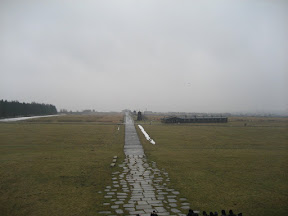 |
| Majdanek. |
Tuesday, day 2: After leaving Yeshivas Chachmei Lublin, we went to the Majdanek extermination camp. We were supposed to go to the cemetery in Lublin first, but the person whom we needed to unlock the gate could not be reached. So we went to Majdanek first, with Rabbi Teller as our guide. It was a somber, emotional experience - especially when, crowded together like sardines in a tiny room near the gas chambers, the Rosh Yeshiva gave an emotional speech ending with him leading us in crying out "SHEMA YISROEL, HASHEM ELOKEINU HASHEM ECHAD!" and then singing the famous Ani Ma'amin sung in the gas chambers. It was one of the most emotional moments in my life.
We then went to the Lublin Jewish cemetery, where we davened at the kevarim of the Chozeh of Lublin, the Maharshal, the Ba'al Yerakos, and others.
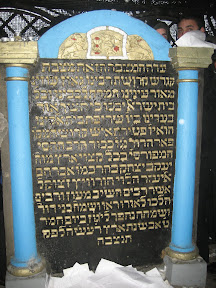 |
| The Chozeh of Lublin. |
Afterward, we left for Krakow. Upon arriving in Krakow at 11:30 PM, we ate supper and then checked into Hotel Galicia for the night.
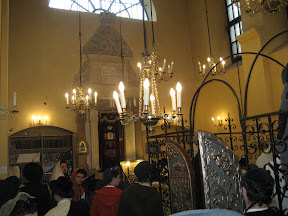 |
| The Rama's shul. |
Wednesday, day 3: We davened Shachris at the Rama's shul, ate breakfast, and then went to the cemetery. We davened at the kevarim of the Rama, the Tosfos Yom Tov, the Megaleh Amukos, Reb Hershele, the Bach, the Ma'or Veshamesh and others.
We left Krakow at noon, and arrived at Auschwitz at around 2:30 PM. We were at Auschwitz itself (the smaller camp, with the famous "Arbeit Macht Frei" gates) until about 4:15 PM; we then went a short distance away to Birkenau (also known as Auschwitz II), the much larger camp with the track leading directly into it, which was where most of the Jewish prisoners actually were.
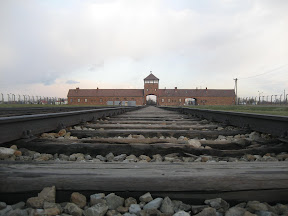 |
| Auschwitz II: Birkenau. |
I won't dwell much on the subject of Auschwitz (and wouldn't even if my thumb weren't injured), because like Majdanek, it is a very difficult and emotional topic for me to write about. I am sure you will understand. Besides, there is enough literature on the subject out there already as it is.
We finally left Auschwitz-Birkenau at around 6:15, and had supper at the nearby "Center for Dialogue" before leaving Poland for good. We arrive in Bratislava (also known as Pressburg), Slovakia, at around 2:00 AM, and check into Hotel Turist (yes, that's how they spell it) for the night.
Thursday, day 4: After a brief shiur from the Rosh Yeshiva in the hotel dining room, we leave for the Pressburg Jewish cemetery. The cemetery was actually once a large one, but only a small part of it remains, in an underground sort of manmade "cave" built to protect it from vandals. We davened at the kevarim of the of the Chasam Sofer and the other tzadikim buried there, including R' Meshulam Igra.
 |
| The old Pressburg Jewish cemetery. |
We left just before noon, and headed for Vienna, Austria.
Once we arrived in Vienna, we pretty much abandoned the bus and went on a "walking tour" of Vienna. Our destinations included: davening Mincha at the Ohel Moshe shul, shopping at the Kosherland supermarket, eating lunch at the "Milk & Honey" restaurant, a statue depicting Aharon Hakohein making peace between people, a memorial to the Austrian Jews killed in the Holocaust, the Judenplatz Museum (a small museum about Vienna's oldest shul), the Schonbrunn Palace (we didn't actually get in due to the late hour, but we did see the entrance, for what it's worth), the place where Hitler yemach shemo held his first rally, and the only shul in Vienna that survived Kristallnacht. We then boarded the bus and headed toward the Czech Republic. Destination: Prague.
And that is where we stand, ladies and gentleman. I am currently sitting in Prague, and I am zonked. Not to mention that my thumb is acting up again... I'm going to sleep. See ya tomorrow!
Tuesday, March 17, 2009
Day 2, 10:30 AM: Yeshivas Chachmei Lublin
We left for Lublin with a new guide on board: a local Polish chap named Malek. Akiva stayed behind to conduct some kind of tour or something for another group in Lizhensk; he would be meeting us later that night.
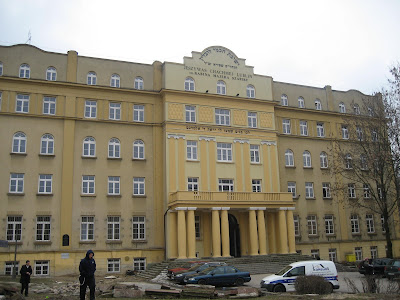
We arrived in Lublin later in the moning, and went straight to the legendary Yeshivas Chachmei Lublin. The yeshiva is housed in a glorious yellow building that until recently was being used by some kind of nursing school or something, before some generous person or persons purchased it back for the Jewish people. It is now slowly being restored to its former glory.
At the yeshiva, we met up with the legendary Rabbi Hanoch Teller, who would be joining us as a tour guide for the next few days.
Rabbi Teller began by first telling us a bit about the history of the yeshiva and of Rabbi Meir Shapiro, and the extraordinary caliber of the talmidim who learned there (an average farher covered between three and five HUNDRED blatt of Gemara by heart). We then went into the yeshiva itself, where we sat in the beis medrash and learned for a few minutes as a reminder of the great yeshiva that was once there, after which we sang and danced a little.
We then looked around at the rest of the building (there were some pictures and other exhibits in some of the rooms adjoining the beis medrash). After that, we went outside to pose for a group picture on the stairs, and then loaded the bus to head out for our next stop.
We arrived in Lublin later in the moning, and went straight to the legendary Yeshivas Chachmei Lublin. The yeshiva is housed in a glorious yellow building that until recently was being used by some kind of nursing school or something, before some generous person or persons purchased it back for the Jewish people. It is now slowly being restored to its former glory.
 |
At the yeshiva, we met up with the legendary Rabbi Hanoch Teller, who would be joining us as a tour guide for the next few days.
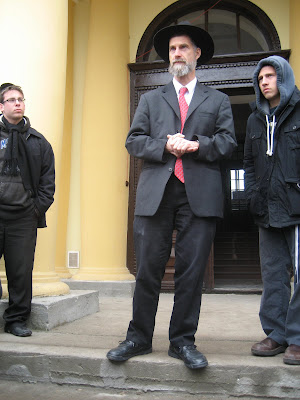 |
Rabbi Teller began by first telling us a bit about the history of the yeshiva and of Rabbi Meir Shapiro, and the extraordinary caliber of the talmidim who learned there (an average farher covered between three and five HUNDRED blatt of Gemara by heart). We then went into the yeshiva itself, where we sat in the beis medrash and learned for a few minutes as a reminder of the great yeshiva that was once there, after which we sang and danced a little.
We then looked around at the rest of the building (there were some pictures and other exhibits in some of the rooms adjoining the beis medrash). After that, we went outside to pose for a group picture on the stairs, and then loaded the bus to head out for our next stop.
Day 2, 8:30 AM: Recap of Lizhensk
After spending pretty much the whole day travelling, we arrived in Lizhensk at a little after 11 PM. We davened Maariv together in the shul before heading off up the hill to the tzion of Rabbi Elimelech of Lizhensk.
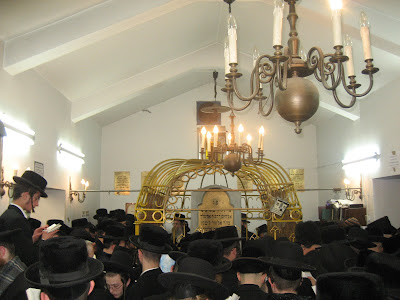
If I had to describe what the scene looked like in as few words as possible, I would use just one: Meron. The scene was strongly reminiscent of Meron on Lag Ba'omer, albeit on a much smaller scale. At the top of the hill is the Ohel, with the path leading up to it lined with people collecting tzedaka for various causes, distributing candles, selling souvenir coins blessed by the venerable His-Name-Escapes-Me-At-The-Moment Rebbe, etc. The Ohel itself is so packed with people that I could not honestly testify in a court of law that my feet were touching the ground the entire time as I made (read: squeezed) my way to the kever itself. It's a sight to behold: people from all walks of life, all gathering at the tzion of the holy Rebbe on the day of his yahrtzeit to pour out their hearts to our Father in Heaven, ad beg for a yeshuah in the merit of this great tzaddik.
At the bottom of the hill, once again similar to Meron, lots of evidence is visible that the Lizhensk Hachnassas Orchim organization is hard at work. From providing for the community the simple service of marking off the area until which kohanim are allowed to go, to providing buffet-style meals to thousands of people free of charge 24 hours a day, these people are amazing. The also distribute candles, have a crew of goyim keeping the place clean at all times - they even have a cellphone charging gemach.
Really, I kid you not. Near the "buffet", they have a bank of like two dozen different cellphone chargers plugged into two power strips taped back-to-back, with plug tips for almost every cellphone around. You just find the one that matches your phone and plug in, and you're ready to juice up.
Anyway, after Maariv, we were presented with a bit of a problem. The original plan was to leave Lizhensk at 3 AM for Lublin and sleep on the bus. However, these Eastern Europeans have some kind of irritating law (like most of their laws) that every bus must lay over for 9 hours at night. Even if you have a brand new driver, it doesn't help - to put things in lomdishe terms, "the issur is chal on the cheftza", meaning that the bus itself must "rest". If you can imagine.
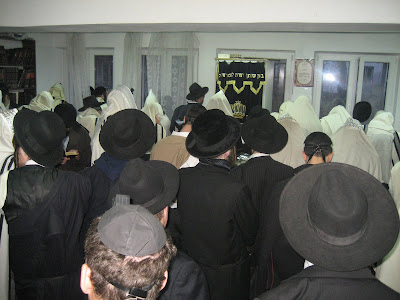
So as a result, we would have no transportation until 8 AM the next morning, leaving us with a whole lot of hours to fill, with not much to do besides davening. And daven we did. We davened, we danced, some of us fell asleep in various hallways and corners of various rooms throughout the complex - eventually, morning came, and we all davened Shachris together at vasikin.
After Shachris, the Rosh Yeshiva went with a bunch of guys to go daven at the tzion again one last time, this time as a minyan. We then ate breakfast at the Hachnassas Orchim's dining room, and packed up lunches using the supplies they provided us with. We then did one last rekidah, and headed back to the bus, shortly after 8 AM.
Next stop: Lublin.
 |
If I had to describe what the scene looked like in as few words as possible, I would use just one: Meron. The scene was strongly reminiscent of Meron on Lag Ba'omer, albeit on a much smaller scale. At the top of the hill is the Ohel, with the path leading up to it lined with people collecting tzedaka for various causes, distributing candles, selling souvenir coins blessed by the venerable His-Name-Escapes-Me-At-The-Moment Rebbe, etc. The Ohel itself is so packed with people that I could not honestly testify in a court of law that my feet were touching the ground the entire time as I made (read: squeezed) my way to the kever itself. It's a sight to behold: people from all walks of life, all gathering at the tzion of the holy Rebbe on the day of his yahrtzeit to pour out their hearts to our Father in Heaven, ad beg for a yeshuah in the merit of this great tzaddik.
 |
At the bottom of the hill, once again similar to Meron, lots of evidence is visible that the Lizhensk Hachnassas Orchim organization is hard at work. From providing for the community the simple service of marking off the area until which kohanim are allowed to go, to providing buffet-style meals to thousands of people free of charge 24 hours a day, these people are amazing. The also distribute candles, have a crew of goyim keeping the place clean at all times - they even have a cellphone charging gemach.
Really, I kid you not. Near the "buffet", they have a bank of like two dozen different cellphone chargers plugged into two power strips taped back-to-back, with plug tips for almost every cellphone around. You just find the one that matches your phone and plug in, and you're ready to juice up.
Anyway, after Maariv, we were presented with a bit of a problem. The original plan was to leave Lizhensk at 3 AM for Lublin and sleep on the bus. However, these Eastern Europeans have some kind of irritating law (like most of their laws) that every bus must lay over for 9 hours at night. Even if you have a brand new driver, it doesn't help - to put things in lomdishe terms, "the issur is chal on the cheftza", meaning that the bus itself must "rest". If you can imagine.
So as a result, we would have no transportation until 8 AM the next morning, leaving us with a whole lot of hours to fill, with not much to do besides davening. And daven we did. We davened, we danced, some of us fell asleep in various hallways and corners of various rooms throughout the complex - eventually, morning came, and we all davened Shachris together at vasikin.
 |
After Shachris, the Rosh Yeshiva went with a bunch of guys to go daven at the tzion again one last time, this time as a minyan. We then ate breakfast at the Hachnassas Orchim's dining room, and packed up lunches using the supplies they provided us with. We then did one last rekidah, and headed back to the bus, shortly after 8 AM.
Next stop: Lublin.
Day 1, 11:00 PM: The Ropshitzer
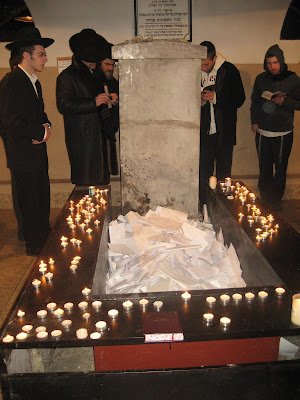 |
We paid a relatively brief visit to the tomb of R' Naftali of Ropshitz on our way to Lizhensk. Akiva give us a quick speech about R' Naftali before we got off the bus: how he always served Hashem with simcha, and used badchanus as his avodah.
In fact, the Chozeh of Lublin once felt himself unable to recite tikkun chatzos, and later discovered that R' Naftali was engaged in a badchanus routine at the time. "His badchanus is greater than my weeping over the Beis Hamikdash", he said.
May has memory be a blessing.
Monday, March 16, 2009
Day One, 5:30 PM: Somewhere in Slovakia...
Okay, we're on the road now. Not that there's anything really special about that at this point; I estimate that we'll be spending about 27 hours per day on the road over the next week. It's the stops in between that will count. Here's what's been going on so far:
At roughly 9:00 AM, we landed at the Ferighy Airport in Budapest. Our little school-bus-with-wings spat us out into two standing-room-only buses, which then took us to the terminal. Of course, as an experienced Egged rider, I had no problem with the bus. Once in the terminal, I got through passport control without any problems, Baruch Hashem. I even got a smile from the border control agent for saying "thank you very much" in Hungarian. Baggage claim, on the other hand, was another story for another time, but we managed.
Once out of the terminal, we met our tour guides, Akiva and Reuven, and loaded up our bus.
We took a brief drive through Budapest (brief, because or real visit to Budapest will be on Sunday), eventually visiting a money changer where we each changed about $10 into Forint, the local currency. The Hungarian Forint is one of those near-useless foreign currencies where one US dollar is equivalent to like 63,000,000,000,000,000 units of local currency, although the government plans on dealing with that by switching to the Euro eventually.
After changing money, we went to some local shops in the area, including one little Jewish shop selling products imported from Israel, to by some food and soda. I personally didn't buy anything, since I brought plenty of supplies with me from Israel. So at the moment, I still have all 2,260 of my Hungarian Forint in my pocket, and unless I spend it when we come back on Sunday, I'm gonna have some pretty useless souvenirs. (At least the Euro can be used in other countries; the Forint can only be used in Hungary.)
Anyway, after finishing with the food stores, we said goodbye to Reuven (our local Hungarian guide) until Sunday, and got onto the bus with Akiva (our imported guide from Israel) to begin heading north to Poland, via Slovakia. It's supposed to be an eight hour trip, so don't be surprised if I'm still on the bus in 13 hours or so.
Many of us begin to drop off to sleep as the bus meanders north toward the border, eventually finding Slovakia almost by accident (plus the driver has a GPS unit that keeps yakking in either Russian or Ukrainian. Or both. I don't know and I don't really care). We crossed the border without any incident whatsoever for the very simple reason that there wasn't, technically speaking, anyone guarding the border. There was just an empty booth and some signs, and presto! - we were in Slovakia.
Shortly thereafter, at about 1:30 PM, we pulled over at a gas station to stretch our legs and daven mincha.
Some of us also took advantage of the opportunity to get some food out of the storage area beneath the bus and eat some lunch.
After that, we got back on the bus, and have been on it ever since. We did stop a few times - a couple of times at gas stations for directions or something, and once because a really bored cop decided he wanted to see all our passports, but gave up after like the fifth one - but we didn't actually get off or do anything special since mincha. We've been mostly sleeping, reading, learning, planning the next Slovakian revolution, etc. - nothing too major.
Assuming we haven't actually reached the North Pole by tonight, we should be in Lizhensk, Poland, just in time for the yahrtzeit of Rebbe Elimelech. And that's when the interesting part really starts. Meanwhile, we can just wait.
Tick, tock, tick, tock...
At roughly 9:00 AM, we landed at the Ferighy Airport in Budapest. Our little school-bus-with-wings spat us out into two standing-room-only buses, which then took us to the terminal. Of course, as an experienced Egged rider, I had no problem with the bus. Once in the terminal, I got through passport control without any problems, Baruch Hashem. I even got a smile from the border control agent for saying "thank you very much" in Hungarian. Baggage claim, on the other hand, was another story for another time, but we managed.
Once out of the terminal, we met our tour guides, Akiva and Reuven, and loaded up our bus.
 |
We took a brief drive through Budapest (brief, because or real visit to Budapest will be on Sunday), eventually visiting a money changer where we each changed about $10 into Forint, the local currency. The Hungarian Forint is one of those near-useless foreign currencies where one US dollar is equivalent to like 63,000,000,000,000,000 units of local currency, although the government plans on dealing with that by switching to the Euro eventually.
After changing money, we went to some local shops in the area, including one little Jewish shop selling products imported from Israel, to by some food and soda. I personally didn't buy anything, since I brought plenty of supplies with me from Israel. So at the moment, I still have all 2,260 of my Hungarian Forint in my pocket, and unless I spend it when we come back on Sunday, I'm gonna have some pretty useless souvenirs. (At least the Euro can be used in other countries; the Forint can only be used in Hungary.)
Anyway, after finishing with the food stores, we said goodbye to Reuven (our local Hungarian guide) until Sunday, and got onto the bus with Akiva (our imported guide from Israel) to begin heading north to Poland, via Slovakia. It's supposed to be an eight hour trip, so don't be surprised if I'm still on the bus in 13 hours or so.
Many of us begin to drop off to sleep as the bus meanders north toward the border, eventually finding Slovakia almost by accident (plus the driver has a GPS unit that keeps yakking in either Russian or Ukrainian. Or both. I don't know and I don't really care). We crossed the border without any incident whatsoever for the very simple reason that there wasn't, technically speaking, anyone guarding the border. There was just an empty booth and some signs, and presto! - we were in Slovakia.
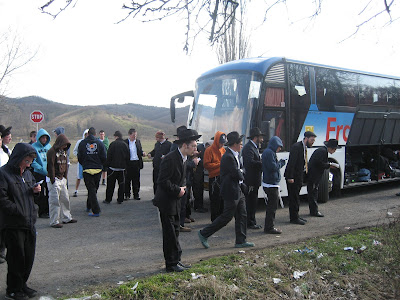
Shortly thereafter, at about 1:30 PM, we pulled over at a gas station to stretch our legs and daven mincha.
 |
Some of us also took advantage of the opportunity to get some food out of the storage area beneath the bus and eat some lunch.
After that, we got back on the bus, and have been on it ever since. We did stop a few times - a couple of times at gas stations for directions or something, and once because a really bored cop decided he wanted to see all our passports, but gave up after like the fifth one - but we didn't actually get off or do anything special since mincha. We've been mostly sleeping, reading, learning, planning the next Slovakian revolution, etc. - nothing too major.
Assuming we haven't actually reached the North Pole by tonight, we should be in Lizhensk, Poland, just in time for the yahrtzeit of Rebbe Elimelech. And that's when the interesting part really starts. Meanwhile, we can just wait.
Tick, tock, tick, tock...
Head (Whole Body, Actually) in the Clouds
I'm sitting here on a plane - a Boeing 737-700, to be specific - flying high above some mountains. I don't know which ones. Maybe they're the Alps. Or the Rockies. Or maybe even the Catskill Mountains (I have my suspicions about that one). All I know is that we're somewhere between Israel and Hungary. In fact, I know that we must be headed to Hungary because everything on this plane says "Malev HUNGARIAN Airlines" in big bold letters (we Hungarians are very proud of our airplanes, thank you very much).
So what am I doing, heading to Hungary? Good question. I'm glad you asked. Let me back up a little, and I'll explain.
My yeshiva has a tradition of organizing a trip each year to mekomos hakdoshim in Eastern Europe for those interested, shortly before Pesach. Last year, for instance, we traveled all over the Ukraine (some of my more keen readers may have spotted references to "The Ukraine Chronicles" in older posts on my blog - that was supposed to be a series of articles about our Ukraine trip, but they never quite materialized). This year, we're travelling to (or at least through) no less than five countries: Hungary, the Czech Republic, Slovakia, Austria, and Poland.
The trip is actually critical in helping the yeshiva function properly in the second half of winter zman. Here's why: as you undoubtedly know, there is an unfortunate syndrome that exists in many yeshivos known as "sof zman": as the long winter zman moves into its waning half, bochurim may begin to slack off a bit and start coming late to - or even skipping - sedorim. Not in our yeshiva, though: we have an "incentive" program, whereby if a bochur comes to all tefilos and sedorim on time (except for a few token misses which are allowed), he will receive discounts on the price of the trip, depending on his record. If a bochur has a near-perfect record for the entire latter part of the zman, plus he accomplishes certain bonus goals - such as making a siyum on the entire masechta being learned in yeshiva - then he earns the entire trip for free.
Baruch Hashem, this program is astonishingly successful, and our beis medrash remains packed with bochurim learning all their sedorim b'hasmada rabbah, long after the point where guys may otherwise begin to drop out. It is truly a kiddush Hashem to behold.
But I'm digressing (you older readers know that I tend to do that quite a bit; you newer readers better get used to it quickly). The point of this article is the trip. And I am pleased to announce that although on last year's trip I was dismally delinquent in in my reporting (come to think of it, this entire YEAR I've been dismally delinquent in my reporting), I will attempt not to be so dismally delinquent this year. (Yeah, I know the "dismally delinquent" stuff is probably getting annoying by now, but I like how it sounds. Dismally delinquent dismally delinquent dismally delinquent.)
This year, I will b'ezras Hashem be reporting directly from the scene... WITH PICTURES. That's right. Pictures. Yeah, I know I used to be against posting pictures on my blog for many reasons (privacy concerns of the people in the pictures, bandwidth consumption for mobile users, etc). But after trying it out with "The Purim Brigade" (below), I decided that maybe pictures are not such a bad idea after all. Especially since, in the words of some famous dead person, "a picture is worth a thousand words" - so that'll make my standard dismally delinquent 800-words-or-so posts a cinch to write.
So join me, dear readers, as we begin our journey into Eastern Europe. You won't even need a passport. You will even be spared the agony of eating dismally delinquent airline food. All you gotta do is check back here on a regular basis. Compared to how I used to post once a week or so back in the day when this blog was popular, this week will be a relative roller-coaster of posts, with a minimum of one or two posts every single day - maybe even more, depending on the amount of activity that day. True, they probably won't be 800-word articles, but it's better than nothing, I assume.
Okay, we should be landing soon. I'm going to stop writing for now. So I'm signing off with these words of wisdom:
Dismally delinquent dismally delinquent dismally delinquent.
So what am I doing, heading to Hungary? Good question. I'm glad you asked. Let me back up a little, and I'll explain.
My yeshiva has a tradition of organizing a trip each year to mekomos hakdoshim in Eastern Europe for those interested, shortly before Pesach. Last year, for instance, we traveled all over the Ukraine (some of my more keen readers may have spotted references to "The Ukraine Chronicles" in older posts on my blog - that was supposed to be a series of articles about our Ukraine trip, but they never quite materialized). This year, we're travelling to (or at least through) no less than five countries: Hungary, the Czech Republic, Slovakia, Austria, and Poland.
The trip is actually critical in helping the yeshiva function properly in the second half of winter zman. Here's why: as you undoubtedly know, there is an unfortunate syndrome that exists in many yeshivos known as "sof zman": as the long winter zman moves into its waning half, bochurim may begin to slack off a bit and start coming late to - or even skipping - sedorim. Not in our yeshiva, though: we have an "incentive" program, whereby if a bochur comes to all tefilos and sedorim on time (except for a few token misses which are allowed), he will receive discounts on the price of the trip, depending on his record. If a bochur has a near-perfect record for the entire latter part of the zman, plus he accomplishes certain bonus goals - such as making a siyum on the entire masechta being learned in yeshiva - then he earns the entire trip for free.
Baruch Hashem, this program is astonishingly successful, and our beis medrash remains packed with bochurim learning all their sedorim b'hasmada rabbah, long after the point where guys may otherwise begin to drop out. It is truly a kiddush Hashem to behold.
But I'm digressing (you older readers know that I tend to do that quite a bit; you newer readers better get used to it quickly). The point of this article is the trip. And I am pleased to announce that although on last year's trip I was dismally delinquent in in my reporting (come to think of it, this entire YEAR I've been dismally delinquent in my reporting), I will attempt not to be so dismally delinquent this year. (Yeah, I know the "dismally delinquent" stuff is probably getting annoying by now, but I like how it sounds. Dismally delinquent dismally delinquent dismally delinquent.)
This year, I will b'ezras Hashem be reporting directly from the scene... WITH PICTURES. That's right. Pictures. Yeah, I know I used to be against posting pictures on my blog for many reasons (privacy concerns of the people in the pictures, bandwidth consumption for mobile users, etc). But after trying it out with "The Purim Brigade" (below), I decided that maybe pictures are not such a bad idea after all. Especially since, in the words of some famous dead person, "a picture is worth a thousand words" - so that'll make my standard dismally delinquent 800-words-or-so posts a cinch to write.
So join me, dear readers, as we begin our journey into Eastern Europe. You won't even need a passport. You will even be spared the agony of eating dismally delinquent airline food. All you gotta do is check back here on a regular basis. Compared to how I used to post once a week or so back in the day when this blog was popular, this week will be a relative roller-coaster of posts, with a minimum of one or two posts every single day - maybe even more, depending on the amount of activity that day. True, they probably won't be 800-word articles, but it's better than nothing, I assume.
Okay, we should be landing soon. I'm going to stop writing for now. So I'm signing off with these words of wisdom:
Dismally delinquent dismally delinquent dismally delinquent.
Thursday, March 12, 2009
The Purim Brigade
Although most cities celebrate Purim on the fourteenth of Adar, cities like Yerushalayim that were "mukaf chomah" celebrate it on the fifteenth (known in the rest of the world as "Shushan Purim"). So for people living in Yerushalayim, the fourteenth of Adar is just another ordinary day. Some people choose to travel to Bnei Brak or other nearby Purim-celebrating cities for the day (effectively getting two days of Purim), while others just stay home, enjoying the relative peace and quiet (except for the occasional firecracker).
Many bochurim in our yeshiva, however, did something totally different. In what was a first-time-ever occurence, our yeshiva, in conjunction with the orginization "L'chayalim B'ahava", arranged for a busload of our bochurim to travel to an army base in the "Bik'ah" to deliver mishloach manos to the soldiers, and bring them a little bit of Simchas Purim.
We left in the morning, dressed in our Purim costumes, and arrived at "Machaneh Tsha Ma'ot" (Camp Nine Hundred) shortly after noon. The bus parked in an empty lot near the camp, where we worked together to assemble 900 packages of nosh and useful items, to be given out to the soldiers. When we finished, we got back on the bus, and after receiving security clearance, we entered the base itself.
We took the base by storm, taking the soldiers quite by surprise with our singing and dancing. It didn't take long for the simcha to spread to them, however, and they joined us enthusiastically. This scene repeated itself quite a few times as way made our way around the camp. The soldiers were more than happy for the break in their ordinary daily routine, and we were greeted with smiles wherever we went.
Between the various parts of the base we went to, we gave out all 900 mishloach manos packages we brought along, and spent several hours shmoozing and singing with the soldiers. One of the bochurim even managed to get some of the non-religious soldiers to put on tefillin.
We finally left after four o'clock in the afternoon, exhausted but happy. The commanders thanked us profusely for coming, saying that our visit was a tremendous morale booster, and that we could not have come at a better time. We were glad for the opportunity to have a great time while making a tremendous kiddush Hashem.


Many bochurim in our yeshiva, however, did something totally different. In what was a first-time-ever occurence, our yeshiva, in conjunction with the orginization "L'chayalim B'ahava", arranged for a busload of our bochurim to travel to an army base in the "Bik'ah" to deliver mishloach manos to the soldiers, and bring them a little bit of Simchas Purim.
We left in the morning, dressed in our Purim costumes, and arrived at "Machaneh Tsha Ma'ot" (Camp Nine Hundred) shortly after noon. The bus parked in an empty lot near the camp, where we worked together to assemble 900 packages of nosh and useful items, to be given out to the soldiers. When we finished, we got back on the bus, and after receiving security clearance, we entered the base itself.
We took the base by storm, taking the soldiers quite by surprise with our singing and dancing. It didn't take long for the simcha to spread to them, however, and they joined us enthusiastically. This scene repeated itself quite a few times as way made our way around the camp. The soldiers were more than happy for the break in their ordinary daily routine, and we were greeted with smiles wherever we went.
Between the various parts of the base we went to, we gave out all 900 mishloach manos packages we brought along, and spent several hours shmoozing and singing with the soldiers. One of the bochurim even managed to get some of the non-religious soldiers to put on tefillin.
We finally left after four o'clock in the afternoon, exhausted but happy. The commanders thanked us profusely for coming, saying that our visit was a tremendous morale booster, and that we could not have come at a better time. We were glad for the opportunity to have a great time while making a tremendous kiddush Hashem.


Wednesday, July 30, 2008
Here, Kitty Kitty!
I figured out why the Israeli government has been cutting child allowance payments and grants to yeshivos. It's because they need the money for other things, like wasting it on rescuing stray cats from weird places.
I kid you not. I went to the Kosel last night to daven Maariv and to say "goodbye", so to speak, since I will be leaving Israel until Elul. When I got there, there were two major commotions in progress: a chefetz chashud (suspicious object, which may be a bomb) was being taken apart by a bomb squad robot, and a cat was stuck on a ledge about 30 feet off the ground right near the Kosel.
I don't know what's wrong with these people, but the cat was getting a LOT more attention than the potential bomb. A major rescue effort was launched, consisting of bringing a device that looked kind of like a free-standing elevator down to the Kosel plaza, and raising it up to the ledge, hoping that the cat would be stupid enough to give up its nice, comfortable perch in the center of attention in favor of a rickety metal platform that was whining and making all kinds of scary mechanical noises.
I don't even know why they were working so hard to try and save the cat - it's not like there's a shortage of cats around here. In fact, scientists estimate that there are approximately 2,000,000,000,000 different cats living under our dira's kitchen window alone. But it certainly made for a good show.
Anyway, when the Einsteins running the show finally realized that the cat wasn't going to climb onto the platform by itself without sending up someone to "help" it, they lowered the platform back down to the ground, and - you guessed it - sent it back up empty again. I'm serious. They actually raised and lowered the platform a few more times without doing a single thing to improve their strategy, as if they expected the cat to eventually give up and say, "alright, alright! I'm coming down!"
Finally, they realized that this just wasn't going to work, so they decided to try and appease the cat by sending it some food. Really. They put a tray with what appeared to be some tuna on it on the platform, and sent it back up.
At this point, the cat finally decided he had enough. Instead of going for the food, it turned around and jumped up a few feet into a window that was just above the ledge, leaving the guys who brought the machine open-mouthed. After a few moments, they just shrugged and lowered the platform down, and then carted the machine away. I kinda felt bad for them - they looked like they were hoping they were gonna get a round of applause when they got down, and now that opportunity was lost forever.
Now, here I am sitting in the airport, and my flight is being delayed. I wonder if maybe it's because there's a cat stuck on the wing...
I kid you not. I went to the Kosel last night to daven Maariv and to say "goodbye", so to speak, since I will be leaving Israel until Elul. When I got there, there were two major commotions in progress: a chefetz chashud (suspicious object, which may be a bomb) was being taken apart by a bomb squad robot, and a cat was stuck on a ledge about 30 feet off the ground right near the Kosel.
I don't know what's wrong with these people, but the cat was getting a LOT more attention than the potential bomb. A major rescue effort was launched, consisting of bringing a device that looked kind of like a free-standing elevator down to the Kosel plaza, and raising it up to the ledge, hoping that the cat would be stupid enough to give up its nice, comfortable perch in the center of attention in favor of a rickety metal platform that was whining and making all kinds of scary mechanical noises.
I don't even know why they were working so hard to try and save the cat - it's not like there's a shortage of cats around here. In fact, scientists estimate that there are approximately 2,000,000,000,000 different cats living under our dira's kitchen window alone. But it certainly made for a good show.
Anyway, when the Einsteins running the show finally realized that the cat wasn't going to climb onto the platform by itself without sending up someone to "help" it, they lowered the platform back down to the ground, and - you guessed it - sent it back up empty again. I'm serious. They actually raised and lowered the platform a few more times without doing a single thing to improve their strategy, as if they expected the cat to eventually give up and say, "alright, alright! I'm coming down!"
Finally, they realized that this just wasn't going to work, so they decided to try and appease the cat by sending it some food. Really. They put a tray with what appeared to be some tuna on it on the platform, and sent it back up.
At this point, the cat finally decided he had enough. Instead of going for the food, it turned around and jumped up a few feet into a window that was just above the ledge, leaving the guys who brought the machine open-mouthed. After a few moments, they just shrugged and lowered the platform down, and then carted the machine away. I kinda felt bad for them - they looked like they were hoping they were gonna get a round of applause when they got down, and now that opportunity was lost forever.
Now, here I am sitting in the airport, and my flight is being delayed. I wonder if maybe it's because there's a cat stuck on the wing...
Tuesday, July 15, 2008
All Aboard the ChaCha Train!
Filed under Tidbits
You know, I knew that my blog had been getting more and more visits lately. Especially since I was pretty much the first person to post the long awaited name of Tinok ben Aviva Feiner (Avraham Yeshayahu, after the Chazon Ish) on the web, being that I did it just moments after the name was given in Jerusalem's Great Synagogue this morning. But you know what really made me feel like I'm finally "on the map"? Getting noticed by ChaCha.
First, a quick little introduction for those of you who have just arrived from some distant planet and do not yet know what ChaCha is: ChaCha is a text-messaging-based mobile search service. Simply put, that means that you can send a text message with any question you want to "CHACHA" (that's 242242 on your phone's keypad), and you will generally get an answer within a short time. For example, you can ask "what is the current exchange rate from US dollars to Israeli Shekels?" or even "what time is candle lighting this Friday evening?" and they will tell you.
See, the way it works is, your question goes to one of ChaCha's many "guides" (people who ChaCha pays to answer questions). The guide performs a quick Google search for the answer, and sends it to your phone via text message. At the end of the answer is a web address that when accessed, shows your question, the answer, some info about the guide who gave the answer, and - here's the important part - a link to the site where the guide got the answer from.
So why am I mentioning all this? Because, like I said before, I am honored that ChaCha has begun to take notice of me. What I mean by that is that believe it or not, on more than one occasion, ChaCha guides have used MY humble blog as the source website for their answers! My blog has provided useful information (if that's even possible) for answering questions about everything from the major snowstorm in Jerusalem this past winter, to details of the aforementioned bris of Avraham Yeshayahu Feiner. So if that's not justification enough for wasting my time writing this thing, well, then I don't know what is.
So in closing, I would like to point out that I have suddenly become a much bigger fan of ChaCha than I already was, now that I see they're becoming bigger fans of me. I highly endorse (assuming I have the power to do that) ChaCha for all your mobile search needs.
But of course, one must weigh that against the fact that when asked recently what the Feiner baby's name is, a ChaCha guide replied: "The baby boy is named Tinok ben Aviva." So I guess maybe they aren't perfect, after all...
NOTE: Unfortunately, ChaCha only works in the USA, not in Israel or anywhere else.
You know, I knew that my blog had been getting more and more visits lately. Especially since I was pretty much the first person to post the long awaited name of Tinok ben Aviva Feiner (Avraham Yeshayahu, after the Chazon Ish) on the web, being that I did it just moments after the name was given in Jerusalem's Great Synagogue this morning. But you know what really made me feel like I'm finally "on the map"? Getting noticed by ChaCha.
First, a quick little introduction for those of you who have just arrived from some distant planet and do not yet know what ChaCha is: ChaCha is a text-messaging-based mobile search service. Simply put, that means that you can send a text message with any question you want to "CHACHA" (that's 242242 on your phone's keypad), and you will generally get an answer within a short time. For example, you can ask "what is the current exchange rate from US dollars to Israeli Shekels?" or even "what time is candle lighting this Friday evening?" and they will tell you.
See, the way it works is, your question goes to one of ChaCha's many "guides" (people who ChaCha pays to answer questions). The guide performs a quick Google search for the answer, and sends it to your phone via text message. At the end of the answer is a web address that when accessed, shows your question, the answer, some info about the guide who gave the answer, and - here's the important part - a link to the site where the guide got the answer from.
So why am I mentioning all this? Because, like I said before, I am honored that ChaCha has begun to take notice of me. What I mean by that is that believe it or not, on more than one occasion, ChaCha guides have used MY humble blog as the source website for their answers! My blog has provided useful information (if that's even possible) for answering questions about everything from the major snowstorm in Jerusalem this past winter, to details of the aforementioned bris of Avraham Yeshayahu Feiner. So if that's not justification enough for wasting my time writing this thing, well, then I don't know what is.
So in closing, I would like to point out that I have suddenly become a much bigger fan of ChaCha than I already was, now that I see they're becoming bigger fans of me. I highly endorse (assuming I have the power to do that) ChaCha for all your mobile search needs.
But of course, one must weigh that against the fact that when asked recently what the Feiner baby's name is, a ChaCha guide replied: "The baby boy is named Tinok ben Aviva." So I guess maybe they aren't perfect, after all...
NOTE: Unfortunately, ChaCha only works in the USA, not in Israel or anywhere else.
Monday, July 14, 2008
I Have Good News and... Well, More Good News
Filed under Tidbits
Tonight's update is about two very special simchas (well, to me, at least), Baruch Hashem.
First of all, it is with great joy and gratitude to Hashem that I report that my sister had a baby girl. (Thereby making me an aunt?) Now, I have plenty of nieces and nephews, b'li ayin hara. But what is special about little Blimi B. is that she is a major milestone for me (well, for our family): this is the thirtieth time I became an uncle. That's right - Uncle Moishe's "fan club" now has 30 members, b'li ayin hara!
Second of all, remember Tinok ben Aviva - the son of Rabbi Eitan Feiner Shlita, who was in the NNICU for several months after he was born? The one whom our "Super Bowl Seder" was to be a z'chus for (covered here)? Well, I am pleased to report that he is doing much better, Baruch Hashem - and is finally having his bris tomorrow morning!
May Klal Yisroel continue to share only simchas from now on!
UPDATE: Tinok ben Aviva finally has a name: Avraham Yeshayahu, after the Chazon Ish. Mazel tov!
Tonight's update is about two very special simchas (well, to me, at least), Baruch Hashem.
First of all, it is with great joy and gratitude to Hashem that I report that my sister had a baby girl. (Thereby making me an aunt?) Now, I have plenty of nieces and nephews, b'li ayin hara. But what is special about little Blimi B. is that she is a major milestone for me (well, for our family): this is the thirtieth time I became an uncle. That's right - Uncle Moishe's "fan club" now has 30 members, b'li ayin hara!
Second of all, remember Tinok ben Aviva - the son of Rabbi Eitan Feiner Shlita, who was in the NNICU for several months after he was born? The one whom our "Super Bowl Seder" was to be a z'chus for (covered here)? Well, I am pleased to report that he is doing much better, Baruch Hashem - and is finally having his bris tomorrow morning!
May Klal Yisroel continue to share only simchas from now on!
UPDATE: Tinok ben Aviva finally has a name: Avraham Yeshayahu, after the Chazon Ish. Mazel tov!
Friday, July 11, 2008
An Interesting Tail
Although we no longer have Tutzy or Norman (who are currently both pursuing lucrative careers in the field of decomposition), there is apparently no shortage of pets to be had in this country. And no, I'm not referring to the cockroaches the size of microwave ovens that one can sometimes find. No, I'm talking about something else completely: I'm talking about donkeys.
I'm not sure what on earth possessed him to do so, but last week a guy from my dira purchased a donkey from some passing Israeli kid for just 100 shekels. I dunno if it was a smart idea, but hey, nobody asked me for my opinion. But hey, a hundred shekels is a small price to pay for some quality entertainment, no?
In fact, when you think about it, it can actually be a pretty good investment. With gasoline going for the equivalent of roughly eight dollars a gallon here in Israel, even a moped ("tus-tus" b'laaz) can start costing some serious cash. A donkey, on the other hand is a nice, convenient, environmentally-friendly grass-powered form of transportation, although perhaps it's a bit bumpy. Plus if you want lots of attention, you don't need to install chrome rims or anything: everyone will be staring at you as it is.
One of my yeshiva's diras has a front yard with a fence around it, so we kept the donkey there. For a week or so it lived there, eating and performing whatever other activities donkeys like to engage in, occasionally being taken for a ride or even just a walk through the streets.
Unfortunately, the fun was not to last. Once of the neighbors, who had apparently been learning the part of this week's parsha (Parshas Balak) about Bilam's donkey with too much kavana - decided to rat us out to the authorities. I didn't know donkey ownership is illegal, but then again, I don't know a whole lot of other things, either. All I know is that the municipality sent someone down to investigate the matter, and when he saw that there was indeed a donkey present, he promptly called for backup - meaning someone with a truck - to come take it away.
Fearing for our beloved pet, two guys distracted the municipal worker, while a third guy snuck the donkey out of there and ran off with it. When the guy with the truck finally came to take away the donkey, it was nowhere to be found. Unfortunately, though, since donkeys are not a very common sight around here, everyone along the escape route noticed it, and thus the municipal people had plenty of eyewitnesses to tell them where the donkey went. They followed the trail of eyewitness accounts all the way to the Arzei Habira park, where they finally caught up with the donkey. Unlike Bilam's donkey, though, ours was unable to talk and defend itself, and thus found itself being taken away in the back of the truck to who-knows-where.
Wherever it is, I hope it's having a good time. And maybe, eventually, it'll meet the grandchild of Bilam's donkey, and learn to tell some good jokes...
I'm not sure what on earth possessed him to do so, but last week a guy from my dira purchased a donkey from some passing Israeli kid for just 100 shekels. I dunno if it was a smart idea, but hey, nobody asked me for my opinion. But hey, a hundred shekels is a small price to pay for some quality entertainment, no?
In fact, when you think about it, it can actually be a pretty good investment. With gasoline going for the equivalent of roughly eight dollars a gallon here in Israel, even a moped ("tus-tus" b'laaz) can start costing some serious cash. A donkey, on the other hand is a nice, convenient, environmentally-friendly grass-powered form of transportation, although perhaps it's a bit bumpy. Plus if you want lots of attention, you don't need to install chrome rims or anything: everyone will be staring at you as it is.
One of my yeshiva's diras has a front yard with a fence around it, so we kept the donkey there. For a week or so it lived there, eating and performing whatever other activities donkeys like to engage in, occasionally being taken for a ride or even just a walk through the streets.
Unfortunately, the fun was not to last. Once of the neighbors, who had apparently been learning the part of this week's parsha (Parshas Balak) about Bilam's donkey with too much kavana - decided to rat us out to the authorities. I didn't know donkey ownership is illegal, but then again, I don't know a whole lot of other things, either. All I know is that the municipality sent someone down to investigate the matter, and when he saw that there was indeed a donkey present, he promptly called for backup - meaning someone with a truck - to come take it away.
Fearing for our beloved pet, two guys distracted the municipal worker, while a third guy snuck the donkey out of there and ran off with it. When the guy with the truck finally came to take away the donkey, it was nowhere to be found. Unfortunately, though, since donkeys are not a very common sight around here, everyone along the escape route noticed it, and thus the municipal people had plenty of eyewitnesses to tell them where the donkey went. They followed the trail of eyewitness accounts all the way to the Arzei Habira park, where they finally caught up with the donkey. Unlike Bilam's donkey, though, ours was unable to talk and defend itself, and thus found itself being taken away in the back of the truck to who-knows-where.
Wherever it is, I hope it's having a good time. And maybe, eventually, it'll meet the grandchild of Bilam's donkey, and learn to tell some good jokes...
Thursday, July 10, 2008
We're Back in Business
Filed under Tidbits
My apologies for the lack of new posts here on the blog recently. I have been having some severe problems recently with my Blogspot account, which prevented me from posting. Long story made short, I had several Blogspot employees burned at the stake, and the rest of them, seeing I meant business, got things working again.
And now, back to myderanged ranting informative journalism...
My apologies for the lack of new posts here on the blog recently. I have been having some severe problems recently with my Blogspot account, which prevented me from posting. Long story made short, I had several Blogspot employees burned at the stake, and the rest of them, seeing I meant business, got things working again.
And now, back to my
Saturday, June 14, 2008
Water, Water Everywhere...
Filed under Tidbits
Try to picture this: I'm walking down Rechov Sonnenfeld this past Friday afternoon, carrying a case of 2-liter Ein Gedi water bottles in my right hand, and two bags of shirts from the cleaners in my left. (Don't ask why they're in bags. For some reason, in this country, someone decided that "boxed" actually means "bagged", and I'm smart enough not to try to ask any dumb questions as to why. I just wonder what you get if you ask for "bagged".)
Anyway, as I approach the intersection of Sonnenfeld and Lendner, almost without warning there is a huge RIIIIIIIP!!! (Kinda like the sound you might end up hearing if you wear pants that are way too small for you.) The case of Ein Gedi water, in a dramatic display of balance, splits in half RIGHT DOWN THE MIDDLE, ejecting 3 bottles out of each side and sending all six 2-liter bottles rolling down the hill, each one racing off in its own direction, some down Sonnenfeld and some down Lendner.
As I toss the shirts aside and go racing after my precious water, I think to myself: someone is gonna get it over the head for this one. I'm not sure who, but someone is gonna get it. I mean, this is ridiculous. What has this world come to?! Exploding water bottle cases?! Whatever shall we do if the terrorists get hold of these things?!
Try to picture this: I'm walking down Rechov Sonnenfeld this past Friday afternoon, carrying a case of 2-liter Ein Gedi water bottles in my right hand, and two bags of shirts from the cleaners in my left. (Don't ask why they're in bags. For some reason, in this country, someone decided that "boxed" actually means "bagged", and I'm smart enough not to try to ask any dumb questions as to why. I just wonder what you get if you ask for "bagged".)
Anyway, as I approach the intersection of Sonnenfeld and Lendner, almost without warning there is a huge RIIIIIIIP!!! (Kinda like the sound you might end up hearing if you wear pants that are way too small for you.) The case of Ein Gedi water, in a dramatic display of balance, splits in half RIGHT DOWN THE MIDDLE, ejecting 3 bottles out of each side and sending all six 2-liter bottles rolling down the hill, each one racing off in its own direction, some down Sonnenfeld and some down Lendner.
As I toss the shirts aside and go racing after my precious water, I think to myself: someone is gonna get it over the head for this one. I'm not sure who, but someone is gonna get it. I mean, this is ridiculous. What has this world come to?! Exploding water bottle cases?! Whatever shall we do if the terrorists get hold of these things?!
Friday, June 13, 2008
Introducing the Tidbits System
I received a complaint about my blog the other day.
Well, that's not really news, since I get complaints about my blog all the time. (Such as: "Who taught you English? Some kind of weird alien from planet Talabojo?") The nature of the complaint wasn't new either: it's one that I get at least 20 times a day. The complaint was that, in a nutshell, my blog is kinda short on reading material these days - in other words, I should be posting a lot more often. But unlike all the other complaints I get of this nature, this one was different. This one was special. This one was unique because...
Okay, I lied. It frankly was not more special than the identical complaints I get from people all the time, who must have way more spare time than I do if they have been reduced to reading my blog as a way of killing time. Oh, sure, they claim they're just interested in knowing more about what goes on in my life. As if I'm really supposed to believe that, when I'm not even so sure I'M so interested in what's going on in my life...
But getting back to the complaint, it got me thinking (which I have to admit must take talent, since I'm sometimes accused of not using my brain often enough). I decided to analyze the situation, and here's what I came up with:
See, the reason I don't post that often is that I've kind of "painted myself into a corner", so to speak. I've gotten into the habit of making my blog posts into these long, 800-word articles, as if this were my own personal newspaper column or something. Which is all very fine and good, except that most topics don't occupy 800 words, even if you really stretch it. So I'm left with two options: either mention a few lines about that topic as part of another full-size post, or simply scrap that topic altogether. And more often than not, I end up going with option B, because it's much simpler.
But due to the aforementioned complaints, I've decided to make some serious changes around here, to accommodate more frequent posting. I will be starting a new category of posts called "tidbits". These will be kind of like mini-posts, possibly only a few sentences in length. The difference is that tidbits will have a "label" at the end of the piece declaring it as such, which you can click on to read only the tidbits. Likewise, ordinary full-size articles will have a label at the end of each one declaring it to be an article, and you can click on the label to view articles only.
Another difference is that tidbits will be announced by a different kind of email notification message than regular articles. You have the option of being notified of tidbits only, articles only, or both (or neither, for that matter). If you want to be added to or removed from either list, now would probably be a great time to let me know.
Anyway, I hope this new system will work out. If you have any questions, comments, or requests, post them in the comments section below.
Well, that's not really news, since I get complaints about my blog all the time. (Such as: "Who taught you English? Some kind of weird alien from planet Talabojo?") The nature of the complaint wasn't new either: it's one that I get at least 20 times a day. The complaint was that, in a nutshell, my blog is kinda short on reading material these days - in other words, I should be posting a lot more often. But unlike all the other complaints I get of this nature, this one was different. This one was special. This one was unique because...
Okay, I lied. It frankly was not more special than the identical complaints I get from people all the time, who must have way more spare time than I do if they have been reduced to reading my blog as a way of killing time. Oh, sure, they claim they're just interested in knowing more about what goes on in my life. As if I'm really supposed to believe that, when I'm not even so sure I'M so interested in what's going on in my life...
But getting back to the complaint, it got me thinking (which I have to admit must take talent, since I'm sometimes accused of not using my brain often enough). I decided to analyze the situation, and here's what I came up with:
See, the reason I don't post that often is that I've kind of "painted myself into a corner", so to speak. I've gotten into the habit of making my blog posts into these long, 800-word articles, as if this were my own personal newspaper column or something. Which is all very fine and good, except that most topics don't occupy 800 words, even if you really stretch it. So I'm left with two options: either mention a few lines about that topic as part of another full-size post, or simply scrap that topic altogether. And more often than not, I end up going with option B, because it's much simpler.
But due to the aforementioned complaints, I've decided to make some serious changes around here, to accommodate more frequent posting. I will be starting a new category of posts called "tidbits". These will be kind of like mini-posts, possibly only a few sentences in length. The difference is that tidbits will have a "label" at the end of the piece declaring it as such, which you can click on to read only the tidbits. Likewise, ordinary full-size articles will have a label at the end of each one declaring it to be an article, and you can click on the label to view articles only.
Another difference is that tidbits will be announced by a different kind of email notification message than regular articles. You have the option of being notified of tidbits only, articles only, or both (or neither, for that matter). If you want to be added to or removed from either list, now would probably be a great time to let me know.
Anyway, I hope this new system will work out. If you have any questions, comments, or requests, post them in the comments section below.
Thursday, May 29, 2008
Hafganah!!!
Okay, we finally have some serious action to talk about. Not a snowstorm or another boring visit from George "Dubya" Bush, but something way more interesting, as measured in total number of dumpsters set on fire. I'm talking about the wave of hafganot that started last night, are continuing tonight, and may continue for the whole next week.
"Hafganah" is the Hebrew term for demonstration. But we're not talking about a simple demonstration by a few bored souls yelling "power to the people!" or some other mindless slogan; we're talking about serious stuff, the kind of demonstration where if Iran fired a missile at us, it would never hit us because it would be blocked by a dense protective layer of flaming garbage receptacles covering the streets of Jerusalem.
See, what happened was that some poor guy from Brazil was killed in a car accident on Kvish Shesh (Highway 6), Rachmana litzlan. Not content with letting the victim rest in peace, the police want to do an autopsy on the body. They want to investigate the "cause of death"; apparently they believe that being dead is not enough proof that something caused the victim to die.
Needless to say, autopsies are forbidden by halacha, so the anti-religious cops are all excited that they have an excuse to tick off the Chareidi community. However, the Chareidi community has no intention whatsoever of taking this sitting down, and so a wave of hafagnot has begun.
Your average protest around here consists of taking the huge green dumpsters that can be found all over Jerusalem, setting their contents ablaze, and pushing them into the street, thereby clogging the city's already delicate traffic system and causing massive jams. Ironically, while making the biggest "hefker velt" possible out of the city, the participants yell "Yerushalayim eino hefker!!!"
Thinking about this system, I decided to carefully analyze the cons and pros of such a protest.
CONS: Such protests are an inconvenience for innocent civilians such as myself, cause untold property damage in the form of destroyed dumpsters (which rumor has it the city will no longer be replacing, forcing the residents and merchants to figure out some other way of disposing of their garbage), cause a major chilul Hashem in the form of non-religious taxi drivers and cops cursing out all chareidim in general, and result major traffic delays and ridiculously altered bus routes (in one case, a number 2 bus headed for the Kosel ended up passing through Denver, Colorado).
PROS: On the other hand, they sure are fun to watch.
So we can be sure that there will be lots more action in the coming days. Last night alone I personally saw protests on Meah She'arim and Shivtei Yisroel, on Yecheskel near Kikar Shabbos, on Yoel near Hoshea, and on Shmuel Hanavi near Kikar Zvill. And those were only the small ones.
I wonder what tonight will bring...
Other news that I never got around to posting:
- Tutzy is dead. She died a few days into the zman; we have no idea what caused her to die, but we sure miss her. We buried her in a dirt lot near my yeshiva, and marked her grave with a small piece of Jerusalem stone
- My refrigerator is dead. Remember the little portable one that I paid a fortune for (specifically, 320 shekels)? Well, it currently keeps things "cold" at a comfortable 75 degrees Fahrenheit. So I'm guessing I got ripped off as usual.
- On the plus side, my dira finally got a full-size refrigerator/freezer combo. So I guess life isn't so bad after all, huh?
- Norman (the turtle) is not dead, although he does a great job of pretending he is.
- I never got around to finishing The Ukrainian Chronicles, and probably never will. Too bad on you. If you don't like it, sue me.
- The dollar hit an all-new low of 3.26 shekels, continuing its trend of declining in value against every major world currency, as well as several major brands of tissue paper.
- Am I forgetting anything else? Post a comment if you think so...
"Hafganah" is the Hebrew term for demonstration. But we're not talking about a simple demonstration by a few bored souls yelling "power to the people!" or some other mindless slogan; we're talking about serious stuff, the kind of demonstration where if Iran fired a missile at us, it would never hit us because it would be blocked by a dense protective layer of flaming garbage receptacles covering the streets of Jerusalem.
See, what happened was that some poor guy from Brazil was killed in a car accident on Kvish Shesh (Highway 6), Rachmana litzlan. Not content with letting the victim rest in peace, the police want to do an autopsy on the body. They want to investigate the "cause of death"; apparently they believe that being dead is not enough proof that something caused the victim to die.
Needless to say, autopsies are forbidden by halacha, so the anti-religious cops are all excited that they have an excuse to tick off the Chareidi community. However, the Chareidi community has no intention whatsoever of taking this sitting down, and so a wave of hafagnot has begun.
Your average protest around here consists of taking the huge green dumpsters that can be found all over Jerusalem, setting their contents ablaze, and pushing them into the street, thereby clogging the city's already delicate traffic system and causing massive jams. Ironically, while making the biggest "hefker velt" possible out of the city, the participants yell "Yerushalayim eino hefker!!!"
Thinking about this system, I decided to carefully analyze the cons and pros of such a protest.
CONS: Such protests are an inconvenience for innocent civilians such as myself, cause untold property damage in the form of destroyed dumpsters (which rumor has it the city will no longer be replacing, forcing the residents and merchants to figure out some other way of disposing of their garbage), cause a major chilul Hashem in the form of non-religious taxi drivers and cops cursing out all chareidim in general, and result major traffic delays and ridiculously altered bus routes (in one case, a number 2 bus headed for the Kosel ended up passing through Denver, Colorado).
PROS: On the other hand, they sure are fun to watch.
So we can be sure that there will be lots more action in the coming days. Last night alone I personally saw protests on Meah She'arim and Shivtei Yisroel, on Yecheskel near Kikar Shabbos, on Yoel near Hoshea, and on Shmuel Hanavi near Kikar Zvill. And those were only the small ones.
I wonder what tonight will bring...
Other news that I never got around to posting:
- Tutzy is dead. She died a few days into the zman; we have no idea what caused her to die, but we sure miss her. We buried her in a dirt lot near my yeshiva, and marked her grave with a small piece of Jerusalem stone
- My refrigerator is dead. Remember the little portable one that I paid a fortune for (specifically, 320 shekels)? Well, it currently keeps things "cold" at a comfortable 75 degrees Fahrenheit. So I'm guessing I got ripped off as usual.
- On the plus side, my dira finally got a full-size refrigerator/freezer combo. So I guess life isn't so bad after all, huh?
- Norman (the turtle) is not dead, although he does a great job of pretending he is.
- I never got around to finishing The Ukrainian Chronicles, and probably never will. Too bad on you. If you don't like it, sue me.
- The dollar hit an all-new low of 3.26 shekels, continuing its trend of declining in value against every major world currency, as well as several major brands of tissue paper.
- Am I forgetting anything else? Post a comment if you think so...
Wednesday, April 9, 2008
Now it's Time to Say Shalom, Uncle Moishe's Going Home...
I'm sitting on a plane, waiting for takeoff for the sixth time in ten days. But this time, there's a difference: instead of the relatively small coach-bus-with-wings aircraft I've been flying on until now, this time it's a jumbo jet - a Boeing 747-400, to be specific. That's because I'm finally going home.
You're probably wondering why this is my sixth flight in ten days. Well, it's simple: I went on a trip with a bunch of guys from my yeshiva, first to Ukraine, and then to Italy. I haven't posted anything about the trip yet because I've been quite busy with the trip itself, and then with packing up to go home for Pesach once I got back to Israel. With Hashem's help, I hope to catch up on that over bein hazmanim.
In the meantime, while I'm waiting for takeoff, I'm taking a few minutes to reflect on the past six months. I'm remembering how apprehensive I was about coming here, how worried I was about what would be if it wouldn't work out. My first time in a foreign country, alone. Could I really make it?
Now, six months later, I am happy to report that in my humble opinion, it has Baruch Hashem been a smashing success. I don't think I ever had such a great zman in my life - not just in ruchnius, but in gashmius as well. Although being cut off from my "supply lines" by a six thousand mile gap was challenging, it was definitely an awesome experience. I had a great time, with lots of interesting experiences, many of which I didn't get a chance to post about (well, at least not yet). Things like my visit to Machneh Yehudah, getting into a fight (not physical, thankfully) with an Arab taxi driver, "The Kosel Project" - these are only some of those which come to mind...
And now, to answer the big question: was it worth it? Definitely. I would do it again in a heartbeat. I am Baruch Hashem blessed with an amazing yeshiva, with the world's greatest Rosh Yeshiva, in the world's holiest city. What could be better?
It is with these reflections that I leave the holy land. But trust me, I'll definitely be back. They're gonna have to cancel all the flights - and most of the freighters - if they don't want me back here.
And now, time for takeoff. See you across the Atlantic!
You're probably wondering why this is my sixth flight in ten days. Well, it's simple: I went on a trip with a bunch of guys from my yeshiva, first to Ukraine, and then to Italy. I haven't posted anything about the trip yet because I've been quite busy with the trip itself, and then with packing up to go home for Pesach once I got back to Israel. With Hashem's help, I hope to catch up on that over bein hazmanim.
In the meantime, while I'm waiting for takeoff, I'm taking a few minutes to reflect on the past six months. I'm remembering how apprehensive I was about coming here, how worried I was about what would be if it wouldn't work out. My first time in a foreign country, alone. Could I really make it?
Now, six months later, I am happy to report that in my humble opinion, it has Baruch Hashem been a smashing success. I don't think I ever had such a great zman in my life - not just in ruchnius, but in gashmius as well. Although being cut off from my "supply lines" by a six thousand mile gap was challenging, it was definitely an awesome experience. I had a great time, with lots of interesting experiences, many of which I didn't get a chance to post about (well, at least not yet). Things like my visit to Machneh Yehudah, getting into a fight (not physical, thankfully) with an Arab taxi driver, "The Kosel Project" - these are only some of those which come to mind...
And now, to answer the big question: was it worth it? Definitely. I would do it again in a heartbeat. I am Baruch Hashem blessed with an amazing yeshiva, with the world's greatest Rosh Yeshiva, in the world's holiest city. What could be better?
It is with these reflections that I leave the holy land. But trust me, I'll definitely be back. They're gonna have to cancel all the flights - and most of the freighters - if they don't want me back here.
And now, time for takeoff. See you across the Atlantic!
Monday, March 10, 2008
Excuse Me, Do You Have the Time?
Okay! It's that time of year again: daylight savings time! Early Sunday morning was the time for the semi-annual pointless ritual of changing every clock you can think of by one hour. You are required by federal law to do so - in fact, if you do not own a watch, you are required to purchase one for the express purpose of changing the time on it (although unfortunately, you may not claim the expense as a deduction for income tax purposes).
Here in Israel we're not changing our clocks until April, so for a while, the time difference between the US and Israel will be just six hours instead of seven. This is excellent for confusing those of us who were finally just barely getting used to the seven hour time difference to begin with. Not that I'm complaining or anything. No siree.
Daylight savings time is referred to by the acronym "DST", which stands for, well, "Daylight Savings Time". Although I personally feel it would be more accurate to say it stands for "Dumb, Silly Thing", because in my opinion, that is exactly what it is: a pointless attempt to "save" daylight, whatever that's supposed to mean.
There is a major misconception that DST was invented by Benjamin Franklin. This directly leads to many people believing that DST has to be a smart idea, because after all, if it was invented by Benjamin Franklin, it must be a brilliant concept. However, we must not forget that Benjamin Franklin was also the same genius who flew a kite in a thunderstorm which got struck by lightning (the kite did, not the thunderstorm), which fried his brain so badly that he spent the rest of his life speaking in silly idioms like "don't think to hunt two hares with one dog" or "we must all hang together, or assuredly we shall all hang separately". So maybe we should be taking his "brainstorms" with a grain - or perhaps a whole sack - of salt.
But as it turns out, that doesn't really matter, because Benjamin Franklin was in fact not the one who invented DST, although he did lament the waste of daylight hours that came about through waking up late and going to sleep late. Or, as Franklin put it: "Early to bed and early to rise, makes a man - OUCH!" (At that point, Franklin was finally smacked across the face by some heroic individual whose name escapes me at the moment, which shouldn't really matter to anyone, since I just made him up anyway out of wishful thinking.)
According to Wikipedia, DST was actually invented by somebody called William Willet. I don't blame him: if I were him, I would also try to come up with some brilliant concept so people would remember me for something other than my absurdly silly name. Mr. Willet published some kind of pamphlet advocating the concept of forcing the day to start earlier after observing that many people's shutters were still closed during his pre-breakfast horse ride. Personally, I'd like to know why he was trying to look into other people's windows - the pamphlet went through nineteen editions, and none of them actually explain this critical detail. Maybe he was trying to make sure they were up for Shachris.
But getting back to the main issue here, another thing that disturbed Mr. Willet, who was an avid golfer, was that he had to cut his round of golf short at dusk. So he came up with the idea of shifting the clock. If DST were implemented, he argued, not only would people's shutters be open in the morning (although I frankly cannot determine the advantage of that, anyway), but he even would be able to play all the way through his round of golf while it was still light outside. Apparently he figured it would be easier to put the whole nation through the hassle of changing their clocks and getting used to a new schedule than it would be to simply start his round of golf a little earlier.
So anyway, fast-forward a bunch of years to today, and that's where the matter stands right now: we have to change our clocks twice a year because of someone's lousy game of golf. This should further highlight what a pathetic sport golf is: in addition to being the only sport where the game would look exactly the same and proceed at exactly the same pace with the exact same level of excitement as it would even if all the players involved were deceased, golf now has the distinction of being the only sport capable of getting the clock changed in its favor.
Hang on, I think there's a thunderstorm brewing outside. Let me go get my kite...
Here in Israel we're not changing our clocks until April, so for a while, the time difference between the US and Israel will be just six hours instead of seven. This is excellent for confusing those of us who were finally just barely getting used to the seven hour time difference to begin with. Not that I'm complaining or anything. No siree.
Daylight savings time is referred to by the acronym "DST", which stands for, well, "Daylight Savings Time". Although I personally feel it would be more accurate to say it stands for "Dumb, Silly Thing", because in my opinion, that is exactly what it is: a pointless attempt to "save" daylight, whatever that's supposed to mean.
There is a major misconception that DST was invented by Benjamin Franklin. This directly leads to many people believing that DST has to be a smart idea, because after all, if it was invented by Benjamin Franklin, it must be a brilliant concept. However, we must not forget that Benjamin Franklin was also the same genius who flew a kite in a thunderstorm which got struck by lightning (the kite did, not the thunderstorm), which fried his brain so badly that he spent the rest of his life speaking in silly idioms like "don't think to hunt two hares with one dog" or "we must all hang together, or assuredly we shall all hang separately". So maybe we should be taking his "brainstorms" with a grain - or perhaps a whole sack - of salt.
But as it turns out, that doesn't really matter, because Benjamin Franklin was in fact not the one who invented DST, although he did lament the waste of daylight hours that came about through waking up late and going to sleep late. Or, as Franklin put it: "Early to bed and early to rise, makes a man - OUCH!" (At that point, Franklin was finally smacked across the face by some heroic individual whose name escapes me at the moment, which shouldn't really matter to anyone, since I just made him up anyway out of wishful thinking.)
According to Wikipedia, DST was actually invented by somebody called William Willet. I don't blame him: if I were him, I would also try to come up with some brilliant concept so people would remember me for something other than my absurdly silly name. Mr. Willet published some kind of pamphlet advocating the concept of forcing the day to start earlier after observing that many people's shutters were still closed during his pre-breakfast horse ride. Personally, I'd like to know why he was trying to look into other people's windows - the pamphlet went through nineteen editions, and none of them actually explain this critical detail. Maybe he was trying to make sure they were up for Shachris.
But getting back to the main issue here, another thing that disturbed Mr. Willet, who was an avid golfer, was that he had to cut his round of golf short at dusk. So he came up with the idea of shifting the clock. If DST were implemented, he argued, not only would people's shutters be open in the morning (although I frankly cannot determine the advantage of that, anyway), but he even would be able to play all the way through his round of golf while it was still light outside. Apparently he figured it would be easier to put the whole nation through the hassle of changing their clocks and getting used to a new schedule than it would be to simply start his round of golf a little earlier.
So anyway, fast-forward a bunch of years to today, and that's where the matter stands right now: we have to change our clocks twice a year because of someone's lousy game of golf. This should further highlight what a pathetic sport golf is: in addition to being the only sport where the game would look exactly the same and proceed at exactly the same pace with the exact same level of excitement as it would even if all the players involved were deceased, golf now has the distinction of being the only sport capable of getting the clock changed in its favor.
Hang on, I think there's a thunderstorm brewing outside. Let me go get my kite...
Wednesday, February 13, 2008
Elevating the Super Sunday
I should have posted this a week ago. I really should have; I just didn't have the time. But like they say, "better late than never". Especially when the subject is something as amazing as what I am about to tell you.
Sometimes you come across something so wonderful, an idea so incredible, that you have no idea how to describe it. But you have to try. And thus, I will try to describe what transpired in my yeshiva last Sunday night.
First, let me give you a little background information. Let's analyze what was going on in the rest of the world. For those of you who are not followers of sports, last Sunday night was the Super Bowl (I'm not into sports either, mind you, but even I heard of it). The Super Bowl is the championship game of the National Football League. It is perhaps the most watched sports event in the world. Additionally, "Super Sunday", as it is called, is the second-largest U.S. food consumption day, following Thanksgiving. So you can imagine what a big deal it is.
People all over the world watch the Super Bowl, even here in Israel. With the advent of Internet broadcasting, there is almost no corner of the world left untouched by this frenzy. Almost.
I say "almost" because I am here to tell you about a place in the world that is an exception to the rule, an oasis of normalcy in this insane world. I am here to tell you about my yeshiva, and the Kiddush Hashem we made. On a night when millions of people were watching a bunch of grown men chasing a ball, we dedicated the night to Hakadosh Baruch Hu. We stayed up the whole night and learned.
This is actually the second year that my yeshiva has done this, but only my first year here, so it's only my first time experiencing it. The fact that we do this on the night of the Super Bowl has earned it nicknames like "Torah Bowl" or "Super Seder". But whatever you call it, the idea is the same: to dedicate a night to Hashem. And not just any night: a night when the rest of the world is busy with other pursuits, and there is a very strong nisayon (for some people, at least) to join them. A night when the world is full of tumah, we attempt to turn it into a night of kedusha.
It is interesting to note that even though the seder was not mandatory, everyone nevertheless participated. And I mean EVERYONE: bochurim, avreichim, rebbeim - it looked like the middle of the day.
This year's seder was dedicated as a z'chus for the refuah sheleimah of the three-week-old son of Rabbi Eitan Feiner Shlita. Rabbi Feiner is a famous lecturer for Gateways, and a close friend of my rosh yeshiva. He speaks in our yeshiva every second Monday night. His son, who was born several weeks ago after many years of childlessness, has been in the NNICU (Neo-Natal Intensive Care Unit) since he was born. The doctors have absolutely no idea what is wrong with him; they say that in the history of medicine, they have never seen a case like this one.
When Rabbi Feiner heard that the seder is being dedicated as a z'chus for his son, he was so touched that he said he wanted to be part of it. And thus he came to join us, and he spoke for us at 1:00 AM. He spoke very well - in fact, it was one of the best speeches I have heard recently, and I hope to soon be able to post it online so that you can download and enjoy it as well.
After staying up the whole night learning, the whole yeshiva walked together to the Kosel to daven Shachris vasikin. After davening, we danced in a circle and sang "ashreinu, mah tov chelkeinu, uma na'im goraleinu" - how lucky we are, how good is our portion, how sweet is our lot. Truer words have never been sang, I thought, watching the rising sun. We were not the only ones to stay up all night, I'm sure... but we are fortunate that we, at least, have what to show for it. We made a Kiddush Hashem.
May it indeed be a z'chus refuah sheleimah for Tinok ben Aviva, b'soch shaar cholei Yisroel. Amen.
Sometimes you come across something so wonderful, an idea so incredible, that you have no idea how to describe it. But you have to try. And thus, I will try to describe what transpired in my yeshiva last Sunday night.
First, let me give you a little background information. Let's analyze what was going on in the rest of the world. For those of you who are not followers of sports, last Sunday night was the Super Bowl (I'm not into sports either, mind you, but even I heard of it). The Super Bowl is the championship game of the National Football League. It is perhaps the most watched sports event in the world. Additionally, "Super Sunday", as it is called, is the second-largest U.S. food consumption day, following Thanksgiving. So you can imagine what a big deal it is.
People all over the world watch the Super Bowl, even here in Israel. With the advent of Internet broadcasting, there is almost no corner of the world left untouched by this frenzy. Almost.
I say "almost" because I am here to tell you about a place in the world that is an exception to the rule, an oasis of normalcy in this insane world. I am here to tell you about my yeshiva, and the Kiddush Hashem we made. On a night when millions of people were watching a bunch of grown men chasing a ball, we dedicated the night to Hakadosh Baruch Hu. We stayed up the whole night and learned.
This is actually the second year that my yeshiva has done this, but only my first year here, so it's only my first time experiencing it. The fact that we do this on the night of the Super Bowl has earned it nicknames like "Torah Bowl" or "Super Seder". But whatever you call it, the idea is the same: to dedicate a night to Hashem. And not just any night: a night when the rest of the world is busy with other pursuits, and there is a very strong nisayon (for some people, at least) to join them. A night when the world is full of tumah, we attempt to turn it into a night of kedusha.
It is interesting to note that even though the seder was not mandatory, everyone nevertheless participated. And I mean EVERYONE: bochurim, avreichim, rebbeim - it looked like the middle of the day.
This year's seder was dedicated as a z'chus for the refuah sheleimah of the three-week-old son of Rabbi Eitan Feiner Shlita. Rabbi Feiner is a famous lecturer for Gateways, and a close friend of my rosh yeshiva. He speaks in our yeshiva every second Monday night. His son, who was born several weeks ago after many years of childlessness, has been in the NNICU (Neo-Natal Intensive Care Unit) since he was born. The doctors have absolutely no idea what is wrong with him; they say that in the history of medicine, they have never seen a case like this one.
When Rabbi Feiner heard that the seder is being dedicated as a z'chus for his son, he was so touched that he said he wanted to be part of it. And thus he came to join us, and he spoke for us at 1:00 AM. He spoke very well - in fact, it was one of the best speeches I have heard recently, and I hope to soon be able to post it online so that you can download and enjoy it as well.
After staying up the whole night learning, the whole yeshiva walked together to the Kosel to daven Shachris vasikin. After davening, we danced in a circle and sang "ashreinu, mah tov chelkeinu, uma na'im goraleinu" - how lucky we are, how good is our portion, how sweet is our lot. Truer words have never been sang, I thought, watching the rising sun. We were not the only ones to stay up all night, I'm sure... but we are fortunate that we, at least, have what to show for it. We made a Kiddush Hashem.
May it indeed be a z'chus refuah sheleimah for Tinok ben Aviva, b'soch shaar cholei Yisroel. Amen.
Wednesday, January 30, 2008
Winter Wonderland?
You know, if you stick around Israel long enough, you get to see some pretty interesting things that you would never otherwise see in your life, such as the Egged No. 2 bus arriving on time. Last night and today, I got to see something very interesting that I may otherwise have never seen: a snowstorm in Yerushalayim.
Six months ago, I never would have dreamed of witnessing snow in Yerushalayim. That's because I never dreamed I would come to learn in yeshiva on this side of the Atlantic. I figured the only time I would ever come to Israel would be to visit, and the chances of running into an Israeli snowstorm during a short visit are probably about as good as Ariel Sharon's chances of becoming Prime Minister again in his current vegetative state (although considering what an incompetent fool Olmert is, Sharon would probably be more competent even if he were deceased).
But time has passed, things have changed, and now here I am, learning in Israel. And here I am, experiencing my first ever Israeli snowstorm.
Snow is very uncommon in most of Israel; non-existent, even, in certain parts of the country. (And you thought only Customer Service was so hard to find, eh?) My brother-in-law tells me that people from B'nei Brak come all the way to Yerushalayim when it snows just to witness this amazing sight. And of course, whenever it snows, the cover of every self-respecting Jewish American newspaper is required by federal law to show the same picture: the Kosel plaza covered in snow.
Two of my friends, who I will refer to only as "Y." and "A." so that you will not figure out that they are "Yechiel" and "Avrumy" (and I certainly will not tell you their last names out of a sincere desire not to find a huge, wet snowball inside my pillowcase as punishment for disclosing their identities), decided to get such a picture. But while most run-of-the-mill (meaning "sane") would-be photographers would wait until a decent amount of snow had accumulated, Y. and A. decided to hike to the Kosel just a short while after it started snowing... at one o'clock in the morning.
They actually invited me to go along with them and have a snowball fight along the way; however, I am pleased to report that my brain is still somewhat functional, and thus I declined. In the short walk back to my dira, I had already gotten soaked to the bone even without the benefit of being pelted with wet wads of slush travelling at speeds exceeding one hundred miles per hour, so I could only imagine what I would look like after a nice, fun-filled hike in such glorious weather. Besides, I don't have any gloves here, so if I tried making snowballs, my fingers would probably be ready to crack off after the third one.
But Y. and A. made it all the way there, and came back looking like they forgot to take off their clothing before diving into the swimming pool. They got some pretty interesting pictures of the virtually empty Kosel plaza, but as I predicted, there wasn't much snow to be seen. In fact, most of the white stuff in the pictures was actually kvittelach wedged into the cracks in the wall, not snow. But hey - who's gonna know the difference, anyway?
But unfortunately, the nice part did not last very long. Although we were expecting approximately 20 centimeters (8 inches) of snow, we never made it that far - the snowstorm changed into a heavy rainstorm, making a big, wet, sloppy mess of the streets. And since this country does not possess snowplows - apparently, they've never even heard of such wondrous inventions, except perhaps in fairy tales - the stuff is not gonna get cleared, either. It will have to melt on its own, which will be no easy feat, seeing as how the weather does not seem to be improving. Not only does the precipitation continue, but it keeps changing every so often between rain, snow, sleet, and occasionally even hail.
I guess it goes without saying that most people here do not have proper winter gear, including me. Jerusalem stone is slippery enough as it is, but a slush-covered sidewalk made of the stuff has me sorely missing my Yaktrax. And let me tell you a little secret: not having boots is probably not the smartest idea either, if you prefer to keep your feet dry.
Many local establishments have bravely responded to the adverse conditions by remaining closed today. I don't think the Egged buses were running either, and the taxis that were operating today were having a field day, charging as much as five times the normal rate for some trips. And you would have to be really brave (meaning "stupid") to try to drive a moped in this weather.
The truth is, the snow alone probably wouldn't have been too bad. A snow-covered Yerushalayim would even make a nice postcard picture. It's when things started getting slushy that everything went to pot. In fact, when I first started writing this post, I titled it simply "Winter Wonderland", since it was still snowing nicely. It was only when the snow switched to rain that I added the question mark, since that's when I realized that the kind of weather we're gonna have is the kind where you get the feeling that it should be illegal to have to get out of bed in the morning on that day.
But I'm not complaining. I still love Eretz Yisroel, slush or no slush. I'm glad to be here, even in such adverse weather. I'm also excited to have merited the possibly-once-in-a-lifetime experience of witnessing an Israeli snowstorm.
Now, if only I could witness the No. 2 bus arriving on time...
Six months ago, I never would have dreamed of witnessing snow in Yerushalayim. That's because I never dreamed I would come to learn in yeshiva on this side of the Atlantic. I figured the only time I would ever come to Israel would be to visit, and the chances of running into an Israeli snowstorm during a short visit are probably about as good as Ariel Sharon's chances of becoming Prime Minister again in his current vegetative state (although considering what an incompetent fool Olmert is, Sharon would probably be more competent even if he were deceased).
But time has passed, things have changed, and now here I am, learning in Israel. And here I am, experiencing my first ever Israeli snowstorm.
Snow is very uncommon in most of Israel; non-existent, even, in certain parts of the country. (And you thought only Customer Service was so hard to find, eh?) My brother-in-law tells me that people from B'nei Brak come all the way to Yerushalayim when it snows just to witness this amazing sight. And of course, whenever it snows, the cover of every self-respecting Jewish American newspaper is required by federal law to show the same picture: the Kosel plaza covered in snow.
Two of my friends, who I will refer to only as "Y." and "A." so that you will not figure out that they are "Yechiel" and "Avrumy" (and I certainly will not tell you their last names out of a sincere desire not to find a huge, wet snowball inside my pillowcase as punishment for disclosing their identities), decided to get such a picture. But while most run-of-the-mill (meaning "sane") would-be photographers would wait until a decent amount of snow had accumulated, Y. and A. decided to hike to the Kosel just a short while after it started snowing... at one o'clock in the morning.
They actually invited me to go along with them and have a snowball fight along the way; however, I am pleased to report that my brain is still somewhat functional, and thus I declined. In the short walk back to my dira, I had already gotten soaked to the bone even without the benefit of being pelted with wet wads of slush travelling at speeds exceeding one hundred miles per hour, so I could only imagine what I would look like after a nice, fun-filled hike in such glorious weather. Besides, I don't have any gloves here, so if I tried making snowballs, my fingers would probably be ready to crack off after the third one.
But Y. and A. made it all the way there, and came back looking like they forgot to take off their clothing before diving into the swimming pool. They got some pretty interesting pictures of the virtually empty Kosel plaza, but as I predicted, there wasn't much snow to be seen. In fact, most of the white stuff in the pictures was actually kvittelach wedged into the cracks in the wall, not snow. But hey - who's gonna know the difference, anyway?
But unfortunately, the nice part did not last very long. Although we were expecting approximately 20 centimeters (8 inches) of snow, we never made it that far - the snowstorm changed into a heavy rainstorm, making a big, wet, sloppy mess of the streets. And since this country does not possess snowplows - apparently, they've never even heard of such wondrous inventions, except perhaps in fairy tales - the stuff is not gonna get cleared, either. It will have to melt on its own, which will be no easy feat, seeing as how the weather does not seem to be improving. Not only does the precipitation continue, but it keeps changing every so often between rain, snow, sleet, and occasionally even hail.
I guess it goes without saying that most people here do not have proper winter gear, including me. Jerusalem stone is slippery enough as it is, but a slush-covered sidewalk made of the stuff has me sorely missing my Yaktrax. And let me tell you a little secret: not having boots is probably not the smartest idea either, if you prefer to keep your feet dry.
Many local establishments have bravely responded to the adverse conditions by remaining closed today. I don't think the Egged buses were running either, and the taxis that were operating today were having a field day, charging as much as five times the normal rate for some trips. And you would have to be really brave (meaning "stupid") to try to drive a moped in this weather.
The truth is, the snow alone probably wouldn't have been too bad. A snow-covered Yerushalayim would even make a nice postcard picture. It's when things started getting slushy that everything went to pot. In fact, when I first started writing this post, I titled it simply "Winter Wonderland", since it was still snowing nicely. It was only when the snow switched to rain that I added the question mark, since that's when I realized that the kind of weather we're gonna have is the kind where you get the feeling that it should be illegal to have to get out of bed in the morning on that day.
But I'm not complaining. I still love Eretz Yisroel, slush or no slush. I'm glad to be here, even in such adverse weather. I'm also excited to have merited the possibly-once-in-a-lifetime experience of witnessing an Israeli snowstorm.
Now, if only I could witness the No. 2 bus arriving on time...
Sunday, January 27, 2008
BANG!
My dira is suddenly plunged into total darkness: the main fuse has blown for the 4,000th time this week. And it's only Sunday night.
You'd think that we'd be used to it by now, but every time the power blows, it somehow still comes as a rude, unexpected shock (har!) to everyone. And as the guys perform various rituals related to getting the power going again, I begin to think if there is anything I can do about the situation.
I suppose I could write a really nasty post about the situation. It wouldn't help matters much, but it would definitely help me blow off some steam, although considering how cold it is these days, I don't think I could afford any. Besides, there is always the lashon hara aspect of things; in fact, this is actually my third attempt at writing this post - I scrapped the first two drafts despite putting a lot of hard work into them, because I was worried that they contained too much negative information. So let's see if I can try to give a somewhat impartial analysis of the problem:
The main fuse has been blowing steadily for at least the past two months. Nighttime is bitterly cold these days, and apparently, the building's power supply can't handle all the heaters in the dira. It is getting to the point where I am tempted to tape the breaker into the "ON" position, fire hazard or no fire hazard. Worst comes to worst, the wires will catch fire, which will probably make the dira a lot warmer than it is now.
See, the problem is that our main breaker has a capacity of 40 Amps. In laymen's terms, that is a lot of electricity for a one-family dwelling, perhaps, but a pitifully small amount for 21 people spread out across 3 floors. Four electricians have allegedly been here already, and they all claim there is no way to increase the amount of incoming electricity without the cooperation of the electric company. The electric company, in turn, refuses to cooperate because a good deal of the dira consists of (surprise!) an illegal extension.
Meanwhile, pretty much everything here operates on electricity - the lights, the heaters, the hot water boiler, some people's brains, etc. - so we naturally have a bit of a problem. You know how those old-fashioned car radios had a row of buttons that could have no two buttons pushed in at once - whenever you pushed one, all the others would pop out? That's kind of what it's like in my dira: we can have lights, heat, or hot water, but we can't have two of them at the same time. The heat and hot water in particular do not coexist well; if you try turning on the hot water heater (or "dude", as it's called in this country) while too many heaters are on, then BANG! - you can guess what happens next.
The temperature in the dira is also not helped much by the fact that the window above my bed is faulty: thanks to the brilliance of the rocket scientist who installed it, I have a window frame that is about two inches narrower than the opening it is supposed to fill, and that gap lets in an awful lot of cold air. It is slated to be fixed (like everything else around here) sometime during the next century, and in the meantime I have taken to stuffing the gap with all sorts of otherwise useless garbage - towels, plastic bags, politicians, etc. It doesn't really help much, but it's the best I can do for now.
Perhaps the problem wouldn't be so bad if people here had common sense. But simple ideas like turning off your heater - or at least putting it on a lower setting - before turning on the hot water boiler just doesn't seem to occur to some people. "What," they say, "are you crazy?! I should shut off my heater?! It's WINTER, man!"
I've all but given up on trying to educate these people. I've also all but given up on trying to get the yeshiva to do anything about the problem - they claim they're working on it, and I believe them, although I frankly don't know why I do. Somehow, I get the sinking feeling that if this were, say, the Beis Medrash, it would have been fixed ages ago, by hook or by crook. But in the mean time, I'm just gonna have to learn to live with--
BANG!
Sigh. Where's my flashlight?
You'd think that we'd be used to it by now, but every time the power blows, it somehow still comes as a rude, unexpected shock (har!) to everyone. And as the guys perform various rituals related to getting the power going again, I begin to think if there is anything I can do about the situation.
I suppose I could write a really nasty post about the situation. It wouldn't help matters much, but it would definitely help me blow off some steam, although considering how cold it is these days, I don't think I could afford any. Besides, there is always the lashon hara aspect of things; in fact, this is actually my third attempt at writing this post - I scrapped the first two drafts despite putting a lot of hard work into them, because I was worried that they contained too much negative information. So let's see if I can try to give a somewhat impartial analysis of the problem:
The main fuse has been blowing steadily for at least the past two months. Nighttime is bitterly cold these days, and apparently, the building's power supply can't handle all the heaters in the dira. It is getting to the point where I am tempted to tape the breaker into the "ON" position, fire hazard or no fire hazard. Worst comes to worst, the wires will catch fire, which will probably make the dira a lot warmer than it is now.
See, the problem is that our main breaker has a capacity of 40 Amps. In laymen's terms, that is a lot of electricity for a one-family dwelling, perhaps, but a pitifully small amount for 21 people spread out across 3 floors. Four electricians have allegedly been here already, and they all claim there is no way to increase the amount of incoming electricity without the cooperation of the electric company. The electric company, in turn, refuses to cooperate because a good deal of the dira consists of (surprise!) an illegal extension.
Meanwhile, pretty much everything here operates on electricity - the lights, the heaters, the hot water boiler, some people's brains, etc. - so we naturally have a bit of a problem. You know how those old-fashioned car radios had a row of buttons that could have no two buttons pushed in at once - whenever you pushed one, all the others would pop out? That's kind of what it's like in my dira: we can have lights, heat, or hot water, but we can't have two of them at the same time. The heat and hot water in particular do not coexist well; if you try turning on the hot water heater (or "dude", as it's called in this country) while too many heaters are on, then BANG! - you can guess what happens next.
The temperature in the dira is also not helped much by the fact that the window above my bed is faulty: thanks to the brilliance of the rocket scientist who installed it, I have a window frame that is about two inches narrower than the opening it is supposed to fill, and that gap lets in an awful lot of cold air. It is slated to be fixed (like everything else around here) sometime during the next century, and in the meantime I have taken to stuffing the gap with all sorts of otherwise useless garbage - towels, plastic bags, politicians, etc. It doesn't really help much, but it's the best I can do for now.
Perhaps the problem wouldn't be so bad if people here had common sense. But simple ideas like turning off your heater - or at least putting it on a lower setting - before turning on the hot water boiler just doesn't seem to occur to some people. "What," they say, "are you crazy?! I should shut off my heater?! It's WINTER, man!"
I've all but given up on trying to educate these people. I've also all but given up on trying to get the yeshiva to do anything about the problem - they claim they're working on it, and I believe them, although I frankly don't know why I do. Somehow, I get the sinking feeling that if this were, say, the Beis Medrash, it would have been fixed ages ago, by hook or by crook. But in the mean time, I'm just gonna have to learn to live with--
BANG!
Sigh. Where's my flashlight?
Monday, January 14, 2008
Boxed In
I'm missing a chasuna tonight. It's not the first chasuna this winter that I'm missing, and it certainly won't be the last, although it is probably the one I am most disappointed to miss of all the chasunas I've been invited to throughout the winter zman. It's yet another chasuna that I'm missing because it is taking place in America, and I am in Israel.
I have to admit, it makes me feel kind of boxed in, as if I'm living in a different world than my family and friends back home. I mean, I love living here in Eretz Yisroel, and to a certain extent I'm still very much in contact with America - I can still call, email, or SMS people just as if I were in the states - but there are certain barriers that cannot easily be broken. Such as the barrier of location, of being - seemingly - in what may be perceived as "the wrong place at the wrong time".
It takes missing a special event like this to really hammer home the fact that after all is said and done, despite the fact that home is just a phone call away, the Atlantic Ocean is still a formidable barrier that is expensive and time-consuming to cross. And unless the occasion is special enough to warrant it, the barrier will simply not be crossed.
Am I upset? Do I regret being here, instead of America? Of course not. I have the privilege of living here in the holy land, and I am loving every minute of it. I wouldn't trade it for anything. But there are definitely sacrifices to be made, and this is one of them, perhaps even one of the smaller ones. In fact, I am thankful to Hashem for providing me with yet another opportunity, another stepping stone along the path of learning to appreciate that which I do have. After all, there are many possible reasons for a person to miss a wedding, many reasons that are far more mundane. Some that are even dreadful and tragic, chas v'shalom.
I am happy for the chosson and kallah. I am happy for their families. But most of all, I am happy that my reason for not being there is a privileged one.
Mazel tov!
I have to admit, it makes me feel kind of boxed in, as if I'm living in a different world than my family and friends back home. I mean, I love living here in Eretz Yisroel, and to a certain extent I'm still very much in contact with America - I can still call, email, or SMS people just as if I were in the states - but there are certain barriers that cannot easily be broken. Such as the barrier of location, of being - seemingly - in what may be perceived as "the wrong place at the wrong time".
It takes missing a special event like this to really hammer home the fact that after all is said and done, despite the fact that home is just a phone call away, the Atlantic Ocean is still a formidable barrier that is expensive and time-consuming to cross. And unless the occasion is special enough to warrant it, the barrier will simply not be crossed.
Am I upset? Do I regret being here, instead of America? Of course not. I have the privilege of living here in the holy land, and I am loving every minute of it. I wouldn't trade it for anything. But there are definitely sacrifices to be made, and this is one of them, perhaps even one of the smaller ones. In fact, I am thankful to Hashem for providing me with yet another opportunity, another stepping stone along the path of learning to appreciate that which I do have. After all, there are many possible reasons for a person to miss a wedding, many reasons that are far more mundane. Some that are even dreadful and tragic, chas v'shalom.
I am happy for the chosson and kallah. I am happy for their families. But most of all, I am happy that my reason for not being there is a privileged one.
Mazel tov!
Subscribe to:
Posts (Atom)